
When a child asks a question about something they heard in the playground or caught on television, a parent’s answer shapes how they understand the world.
News for families is about more than just the facts: it also encompasses the formats, channels and approaches that help younger children stay informed without feeling overwhelmed. Taking stock of what’s available, comparing approaches and identifying blind spots can help families make practical choices.
News formats for children: comparing the options
Several formats are available for keeping children informed, but they don’t all serve the same purpose. The table below compares the main features of four types of media often mentioned by families.
| Format | Target age group | Frequency | Potential for interaction |
|---|---|---|---|
| Daily print newspaper (e.g. Le Petit Quotidien) | 6-10 years | Daily | Low (passive reading) |
| Weekly magazine (e.g. 1 Jour 1 Actu) | 8-12 years | Weekly | Moderate (quizzes, features) |
| Mobile news app | Ages 10 and up | Daily to continuous | High (notifications, comments) |
| Podcasts and short videos | 7-14 years | Variable | Moderate (guided listening) |
The daily print newspaper remains the only format that provides a regular routine without using a screen. A mobile app, on the other hand, offers instant updates but exposes children to a constant stream of content, making closer parental guidance essential.
To follow Jolis Mômes news, families can use a feed designed to bring together stories that directly affect children’s and parents’ everyday lives, from cultural outings to changes in education.

Distressing TV content: what children actually take in
Television remains the main way children come into contact with the news unintentionally. All it takes is a news bulletin playing during dinner: even when a child seems absorbed in something else, they take in the images and tone before they understand the words.
Anne Cordier, a lecturer and researcher in information and communication sciences, notes that children’s first reaction to the news is often fear. Some say that images come back to them at night as flashes. Before the age of ten, most children don’t seek out the news themselves; they are exposed to it involuntarily.
Psychologist Didier Pleux offers a useful guideline: before the age of fifteen or sixteen, young people are not yet able to move back and forth between reasoning and emotion. The younger the child, the more lasting the impact of violent content can be. According to this specialist, parents often make the mistake of treating their child like a little adult and speaking to them as if they were one.
Parents’ screen use and its ripple effect on families
An article published by Le Devoir on October 31, 2026, describes a less-documented phenomenon: repeated videos on social media warning parents about dangers facing their children can end up heightening adults’ own fears. However, the researchers interviewed caution against drawing firm conclusions, since it is difficult to establish a direct link between these videos and parental behaviour.
The challenge, then, is not just to filter what children see, but also to consider the parent’s emotional state when discussing a sensitive topic.
Children’s age and parenting approach: adapt the conversation to their maturity
Parents often wonder when the right time is to talk about the news. The difference in maturity between a six-year-old and a twelve-year-old preteen can significantly change the approach to take.
- Between the ages of six and eight, specialists recommend answering only the questions children ask, using short sentences and concrete words, without going into geopolitical details they cannot put into context.
- Between eight and eleven, children begin to distinguish reality from fiction. This is the age when child-friendly resources such as newspapers work best, because they provide a structured framework for understanding what they read.
- From the age of twelve, conversations can include ideas such as source reliability and cross-checking information. Media literacy then takes on a critical dimension, not just a factual one.
Answer the question the child asks, not the one the parent assumes they’re asking: this is the guiding principle that emerges from the combined recommendations of several professionals cited in French educational resources.
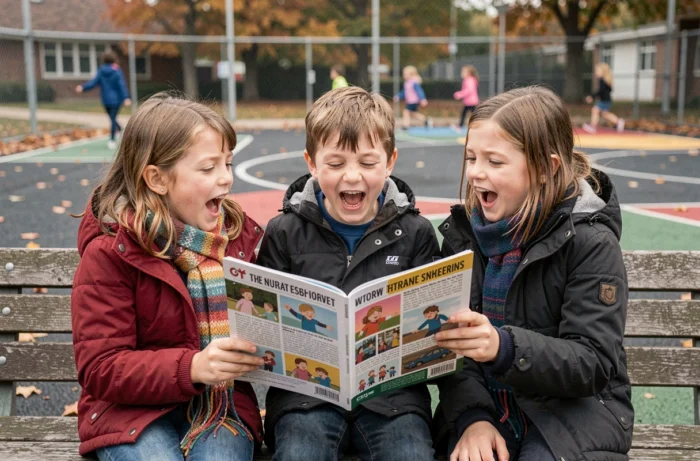
Media literacy at home: a shared role for schools and families
Media literacy now extends beyond the home: schools, public media and public health organisations are stepping up initiatives around children’s digital habits.
These institutional initiatives show that families cannot be solely responsible for addressing children’s digital habits. Schools, public media and public health organisations all contribute to a broader ecosystem.
Even so, the home remains where day-to-day guidance takes place. A parent who discusses a newspaper headline with their child, turns off the TV before a report on an armed conflict or offers an age-appropriate magazine instead of a social media feed is taking practical steps. The aim is less about banning things and more about offering suitable alternatives.
Distinguishing established effects from areas of uncertainty
Separating the well-documented effects of screens (disrupted sleep, less time spent being physically active) from hypotheses that are still being debated (the link between social media and generalised anxiety) can help parents avoid giving in to widespread panic and focus on actions with a proven impact.
Children and parents benefit from positive news, reliable guidance and regular conversations in their everyday lives. The tools are available, the evidence is becoming clearer, and the key factor remains the time each family spends turning the news into a conversation.