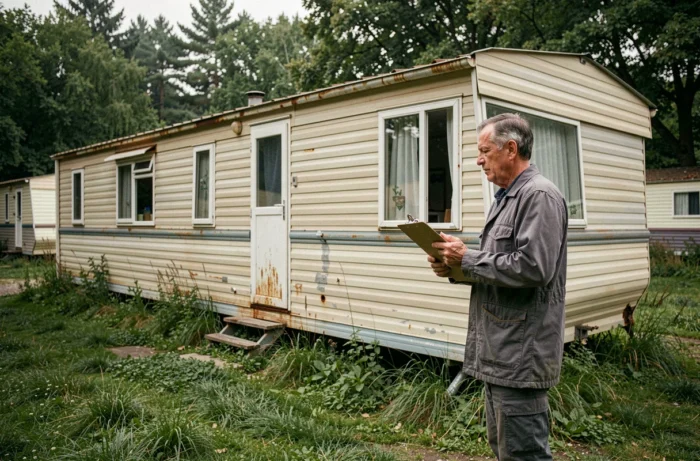
In France, no legislation sets an expiration date for a mobile home. The confusion persists because campsite operators impose their own age limits in pitch rental agreements, and because private individuals are often unfamiliar with the dismantling sector. The actual framework combines private law, technical standards and voluntary environmental schemes, whose scope deserves to be clearly explained.
Legal status of a mobile home: a vehicle, not a building
The French Urban Planning Code classifies a mobile home as a mobile leisure residence. It retains its means of mobility (wheels, chassis, tow bar) and is not considered real property. This classification has a direct consequence: the owner has no right to remain on a campsite pitch or at a residential leisure park (PRL).
The document governing the relationship between the owner and the site operator is the pitch rental agreement. It is this agreement, not national legislation, that sets out clauses relating to the mobile home’s age, condition or replacement. A campsite may require a mobile home to be removed once it reaches a certain age, provided the clause is clearly worded and based on objective criteria (safety, technical compliance, general condition).
The question of recycling older mobile homes often arises when the site operator refuses to renew the agreement. The owner is then left with a vehicle to move or have dismantled, without always knowing what schemes are available.
Wear-and-tear clauses at campsites: what is and isn’t unfair
A clause requiring a mobile home to be replaced solely because it has reached a certain age, without reference to technical criteria, may be deemed unfair under the French Consumer Code. The owner can challenge it in court.
By contrast, a clause providing for an assessment of the mobile home’s actual condition (chassis structure, watertightness, electrical compliance, exterior appearance) is based on objective criteria. This type of clause is generally considered lawful, provided the assessment is conducted jointly or based on standard NF S 56-410, which sets out the safety requirements applicable to mobile leisure residences.
Age alone is not sufficient grounds for eviction from a pitch. A well-maintained mobile home can remain compliant with standards for well over twenty years. Conversely, a poorly maintained recent model can pose safety issues. Wear and tear is a functional concept, not simply a matter of counting years.
What to do if renewal is refused
Reviewing the pitch rental agreement is the first step. If the clause cited by the site operator does not specify any measurable criteria, the owner can request that the mobile home be brought into compliance or contact a consumer mediator before taking legal action.
When leaving the pitch is unavoidable, there are two options:
- Move the mobile home to another authorised site (campsite, PRL). The French Urban Planning Code prohibits installing a mobile leisure residence in a private garden, which severely limits relocation options.
- Arrange for it to be dismantled through the dedicated scheme, avoiding transport costs to a storage site and the risk of illegal dumping.
Dismantling and recycling: the role of Eco-Mobilhome
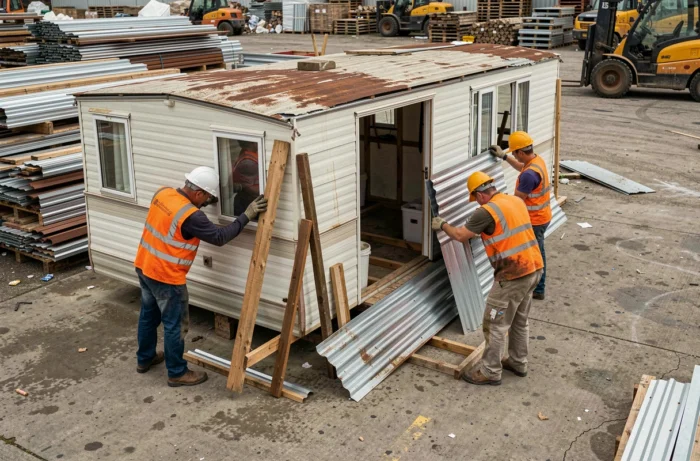
Since 2011, the Eco-Mobilhome eco-organisation has been structuring the end-of-life sector for mobile residences in France. It operates on a simple principle: dismantling is free of charge for private owners as well as campsite operators. The scheme is funded by contributions from manufacturers and distributors of new mobile homes.
Eligibility and how the process works
The service is free for mobile homes installed at a campsite or PRL. Models located on unclassified private land are not always eligible, creating a grey area for owners who have moved their vehicle outside the network.
The process follows a specific logistics chain:
- The owner or site operator submits a request to Eco-Mobilhome.
- An approved dismantling centre, located as close as possible to the installation site, handles the removal.
- Materials (metal, wood, PVC, insulation) are sorted and sent to the appropriate recycling or energy recovery streams.
Material recovery rates are high thanks to the significant proportion of metal and wood in a mobile home’s structure. Steel chassis, which account for a substantial share of the total weight, are fully recyclable.

Installation sites and regulations: a common source of confusion with caravans
Owners of older mobile homes sometimes look to install their vehicle on private land to avoid pitch rental fees. The French Urban Planning Code does not allow this: a mobile leisure residence may only be installed at an authorised campsite or PRL.
This rule differs from the one applying to caravans, which may be parked in a garden under certain conditions (prior declaration for stays exceeding three months). Confusing the two sets of rules can expose the owner to a planning violation and an obligation to restore the land to its original condition.
For a mobile home over twenty years old whose pitch rental agreement is not renewed, the legal options are therefore to find another authorised site or arrange for dismantling. Long-term storage on unclassified land is not a viable option under the regulations.
The free dismantling scheme remains the most accessible option for owners who have nowhere to relocate their mobile home. Checking whether a mobile home is eligible with Eco-Mobilhome before arranging transport or storage can help avoid unnecessary costs and the risk of a planning violation.