
A chest measurement of 104 cm corresponds to a French size 52, while 100 cm corresponds to a size 50. The difference between these two reference points may seem small, but it can be enough to change the fit of a jacket or the comfort of a polo shirt. Understanding what these figures mean in terms of actual body measurements and international equivalents helps avoid the back-and-forth of returns.
Body measurements versus finished garment measurements: the distinction size guides overlook
Brand size charts almost always describe the wearer’s body, not the finished product. A chest measurement of 104 cm listed for size 52 refers to the circumference of the chest, not the width of the garment laid flat.
The finished garment includes varying amounts of ease depending on the style: slim, regular, or oversized. As a result, two shirts labeled size 52 can differ by several centimeters in actual width. We recommend measuring a garment that fits you well while laid flat (chest width, total length, shoulders) and comparing those measurements with the size guide for the brand you’re considering.
To find out what men’s size 52 corresponds to in body measurements, you need at least three reference points: chest, waist, and torso length. Relying on just one figure leads to consistent sizing mistakes.
Measuring a garment laid flat: a quick guide
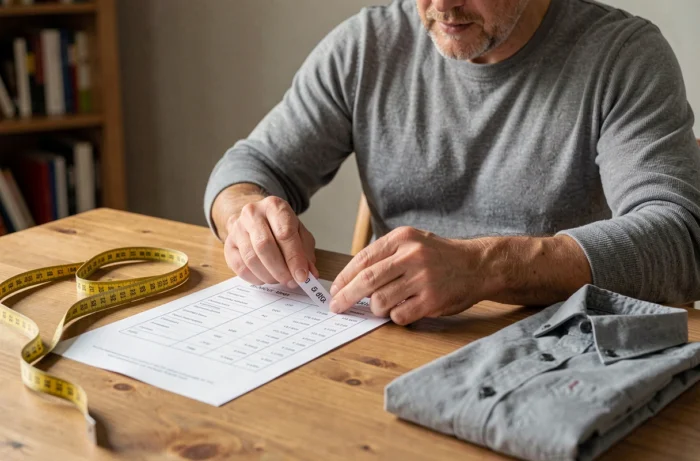
Lay your reference garment, buttoned up, on a flat surface. Measure the width under the arms and double it to get the garment’s chest measurement. Do the same at the waistband for trousers. These flat measurements are more reliable than wrapping a tape measure around your body, especially when ordering online.
Men’s sizes 50-52: international equivalents and conversion pitfalls
French sizes do not have a fixed letter equivalent. Size 50 can correspond to L or XL depending on the brand, while size 52 can be XL or XXL. The European standard EN 13402 sets out reference measurements in centimeters, but each manufacturer uses its own size chart.
The most common conversions for men’s sizes 50-52 are:
- French size 50: chest measurement of around 100 cm, often equivalent to a European L or XL, or a US 40 for jackets.
- French size 52: chest measurement of around 104 cm, often labeled XL or XXL, or a US 42 for jackets.
- In the UK, sizing follows the same general pattern as in the US, but some British brands cut narrower across the shoulders, shifting the equivalent by one size.
These are only general guidelines. Always compare your measurements in centimeters with the brand’s size guide rather than relying on a letter or a US size number.
The case of combined sizes 50/52
Some retailers group sizes 50 and 52 under a single label, such as “50/52” or “L/XL.” This grouping covers a four-centimeter range in chest measurement. If your measurements fall exactly between the two, choose the larger size for a top worn closed (jacket, coat) and the smaller size for a garment worn open or made from stretch fabric (polo shirt, jersey T-shirt).
Men’s trousers in sizes 50-52: why the reference points change
For trousers, the size on the label refers not to the chest measurement but to the waist circumference. Trousers labeled 50 correspond to a waist measurement of around 100 cm, while size 52 corresponds to around 104 cm. Confusion arises because the same number (52) refers to different parts of the body depending on whether it’s a top or a bottom.
Inseam is the second measurement to check. French sizing does not indicate trouser length. US and UK sizing systems sometimes add a length designation (S for short, R for regular, L for long), which helps distinguish between two styles with the same waist measurement.
Three measurements to take for trousers
- Waist: measure at navel level without pulling the tape measure tight.
- Hips: measure around the widest part of the pelvis, as some slim-fit styles can feel tight here even when the waist fits.
- Inseam: measure from the top of the inner thigh to the ankle while standing. Compare this length with the brand’s size guide to avoid a hem that’s too short or fabric that drags on the ground.

Choosing between sizes 50 and 52: how to decide based on the garment
The same person may wear a size 50 T-shirt and a size 52 suit jacket. Chest measurement is the priority for any top, but a structured jacket needs more room in the shoulders and torso than a stretchy knit T-shirt.
For chinos or dress trousers, the key measurements are the waist and hips. If these two measurements correspond to different sizes, choose the size that fits your hips and have a tailor take in the waistband. The reverse—letting out trousers that are too tight at the hips—is rarely satisfactory.
Fabric matters too: raw 100% cotton denim will stretch by a few centimeters after a few wears, while chinos with elastane retain their shape. Taking fabric behavior into account can help you avoid automatically sizing up.
In short, the number printed on the label is only a starting point. Actual body measurements, compared with the finished garment’s measurements, are the only reliable way to choose the right size, whatever sizing system is shown.