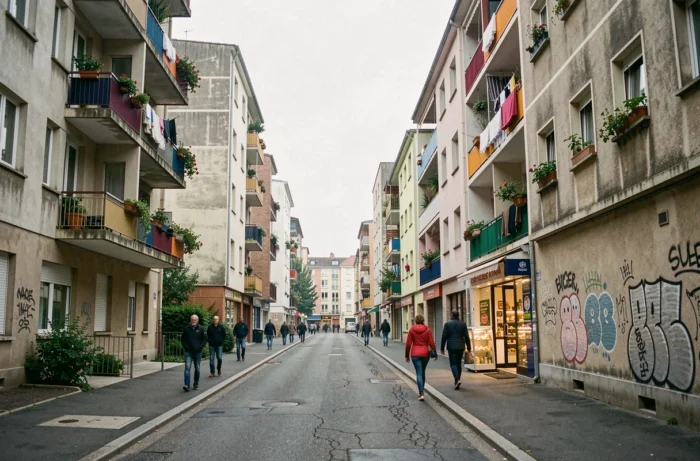
When looking for an apartment in La Paillade, the first things that come up in search engines are words like “dangerous,” “lawless area” or “troubled neighborhood.” Residents’ safety ratings hover around 2 out of 5, below the Montpellier average.
This score reflects how people feel, not a complete assessment. To understand what is really happening in this Mosson neighborhood, you need to look beyond the headlines and see what life on the ground is like.
La Paillade and Mosson: two areas that shouldn’t be confused
On the ground, La Paillade refers to a specific area within the larger Mosson district, which also includes residential neighborhoods, the Mosson stadium and several sports facilities. When it comes to safety, this distinction makes all the difference: tensions are concentrated in specific micro-areas, not across the entire administrative district.
Viral TikTok videos perpetuate a one-dimensional image. They show drug-dealing spots or news stories without distinguishing between a stairwell and a public park three streets away. Thousands of residents are lumped together under a reputation that doesn’t reflect their daily lives.
To get a clearer picture of the dangerous neighborhood of La Paillade in Montpellier, it helps to identify its sub-areas: Tour d’Assas, Grand Mail and the renovated housing developments on the outskirts. Each has its own realities when it comes to peace and quiet and quality of life.
Actual and perceived insecurity: how does La Paillade compare with other neighborhoods?
Comparing La Paillade with other parts of Montpellier offers a more useful perspective than judging it in isolation. Petit Bard-Pergola and Figuerolles experience comparable tensions, with residents regularly reporting drug trafficking and antisocial behavior.
On the Bien dans ma ville website, La Paillade scores 2 out of 5 for safety. Montpellier as a whole scores 2.2. The gap is small. The ratings that show a bigger difference are education (2.6 versus 3.5) and the environment (2.6 versus 3.1). Feelings of insecurity are also shaped by the overall living environment.
Residents most often cite specific problems:
- Visible drug-dealing spots in some stairwells and near certain tower blocks, creating an intimidating presence even for residents who aren’t involved
- Illegal street racing and nighttime noise, concentrated along specific streets in the neighborhood
- A sense of neglect linked to the deterioration of some shared spaces (entrances, underground parking garages and faulty street lighting)
These problems are well documented. But they don’t affect a resident of Grand Mail in the same way as someone living in the renovated apartment buildings on the edge of the neighborhood. The finer details of the area’s geography make all the difference.
Urban renewal in Mosson: projects changing everyday life
A recent example shows how the approach is changing. In 2026, the Maison de l’Architecture de Montpellier launched an architect-in-residence program in the area. The idea is to listen to residents’ stories and needs before drawing up any plans. Previous renovations had often been decided without consulting the local community.
The Neptune aquatic center reopened after two years of construction. For local families, having a working swimming pool nearby directly improves access to leisure activities—something safety ratings don’t capture.
At Grand Mail, low walls have been turned into benches and planters as part of the City of Montpellier’s participatory budgeting program. Young people and high school students from the neighborhood took part in the project. These small-scale, resident-led improvements change how public spaces are used: places people used to avoid become spaces to pass through and meet.
Living in La Paillade: what average ratings don’t capture
La Paillade scores 3.1 out of 5 for sports and leisure, higher than you might expect for a neighborhood portrayed as unlivable. The nearby Mosson stadium and municipal sports facilities contribute to this score.
Public transport generally works well, but temporary service disruptions occur due to rail renovations. During school holidays, construction work can affect connections to the city center. The neighborhood’s accessibility depends on the transport network operating reliably.
The 3 out of 5 rating for everyday convenience reflects the presence of shops, a market and local services. La Paillade offers what is sometimes missing in residential neighborhoods with higher safety ratings: active community groups, a diverse range of shops and a vibrant day-to-day neighborhood life.

La Paillade’s reputation is based on documented problems, but it obscures the range of experiences within the neighborhood itself. Someone moving near the renovated Grand Mail and a tenant in a tower block that hasn’t been refurbished won’t have the same day-to-day experience. The changes underway and the thousands of people who live here without being affected by the incidents endlessly repeated in the news can’t be summed up in a single word.