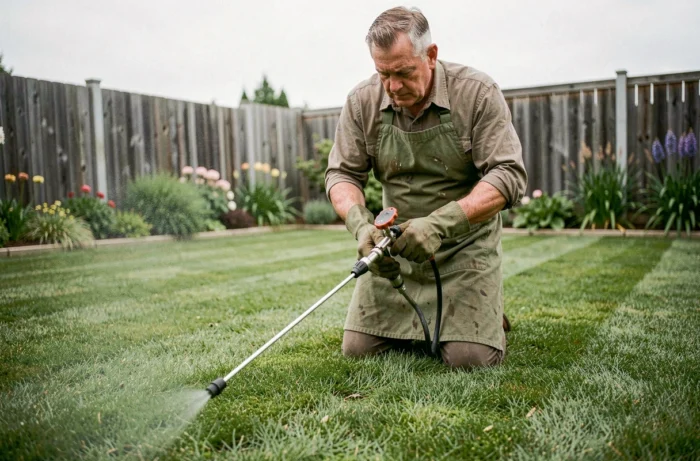
A selective lawn herbicide acts by foliar absorption: the product penetrates through the leaves of the weeds and then migrates to the roots. Mowing, by altering the amount of foliage available, directly interferes with this mechanism. Applying the selective treatment at the wrong time in relation to mowing can reduce its effectiveness or cause burns on the grasses.
The choice between treating before or after mowing depends on the type of formulation, the timing observed, and the condition of the lawn at the time of spraying.
Role of the cuticle and mowing stress on the absorption of the selective treatment
When mowing, the blade cuts through plant tissues and creates open wounds on each blade of grass. These wounds temporarily alter the permeability of the cuticle, the waxy layer that protects the leaves. On lawn grasses, the intact cuticle partially filters the product and limits penetration to tolerable doses. On a fresh cut, this barrier no longer exists at the cut ends.
The problem is twofold. On one hand, freshly cut weeds absorb less product because they have lost part of their leaf surface. On the other hand, grasses injured by mowing become more sensitive to the herbicide, increasing the risk of phytotoxicity, which is visible as yellowing or localized burns.
This mechanism explains why the labels of most products containing 2,4-D, MCPA, or dicamba recommend a delay between mowing and application. The cuticle of the grasses needs to regenerate before receiving the product, and the weeds must have regrown sufficiently to provide an effective contact surface. You will find additional details by consulting lawn solutions on Clic Garden to adapt the sequence to your situation.
Delay between mowing and selective lawn treatment: what the labels recommend
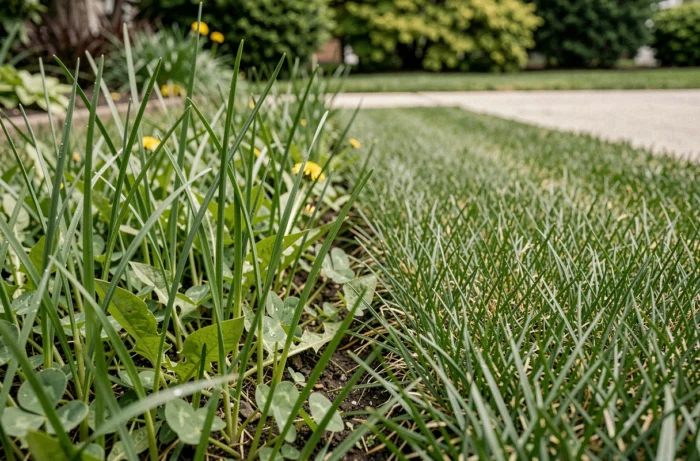
The answer to the question “before or after” hinges on a parameter often overlooked: the delay, not just the order. An American university recommendation (Iowa State) suggests avoiding mowing for two to three days before treatment, then waiting three to four days after spraying. This guideline cannot be directly applied to all products marketed in France, as each formulation has its own instructions on the label.
Why the product label takes precedence over general rules
The active ingredients do not all penetrate at the same speed. A product based on dicamba may require a longer contact time than a product based on MCPA. Concentration, adjuvants, and the type of formulation (liquid, soluble granule) also modify the necessary absorption duration.
Reading the label before planning to mow remains the only reliable reflex. Generic timelines (a few days before, a few days after) serve as safety benchmarks, but they do not replace the specific instructions from the manufacturer.
Mowing before: the logic of regrowth
Mowing a few days before treatment allows weeds to produce new tender leaves, which have a thinner and more permeable cuticle. Dandelions, clover, or plantain quickly regrow foliage after a cut. The regrowth provides a young leaf surface that is more receptive to the product.
This scenario works well in spring and early autumn when weed growth is active. In mid-summer, if the lawn is under water stress, regrowth will be slower and the benefit less pronounced.
Selective treatment and mowing after application: the concrete risks
Mowing too soon after spraying physically removes the product from the leaves before it has penetrated through the cuticle. The active ingredient ends up in the collection bag instead of reaching the roots of the weeds. The treatment is then partially or completely wasted.
Beyond waste, premature mowing disperses product residues into the garden environment. Contaminated mowing waste should not be composted or placed at the base of vegetable plants. Waiting several days after treatment before mowing protects both the effectiveness of the weeding and the subsequent use of green waste.
- If the lawn was treated in the morning, do not mow the same day, even late in the day: the product has not had time to migrate to the roots of the weeds.
- Avoid mowing if rain is forecast in the hours following treatment, as leaching also reduces foliar absorption.
- For soluble granule formulations, ensure that the product has been watered in (if the label requires it) before scheduling the next mowing.
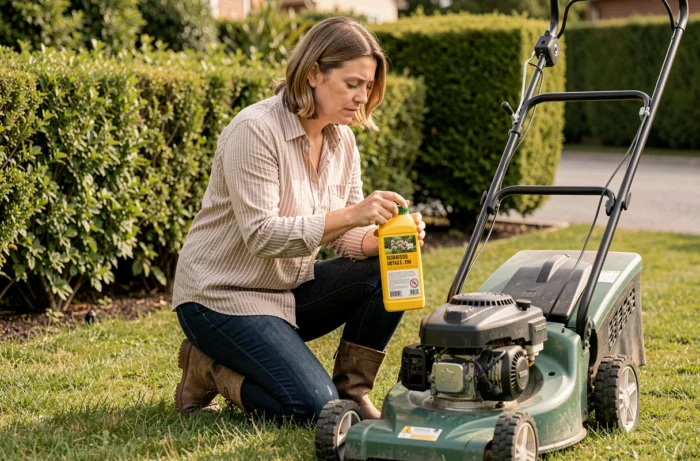
Pre-emergent or post-emergent: the type of herbicide changes the response regarding mowing
All the logic described so far concerns post-emergent herbicides, those applied to already visible weeds that act by foliar contact. Pre-emergent products work differently: they target germinating seeds or young seedlings before they break through the soil surface.
For a pre-emergent product, mowing does not have the same impact on effectiveness since absorption occurs through the soil and emerging roots, not through the leaves. The question of timing before or after mowing becomes secondary.
What matters is not to disturb the layer of product deposited in the soil: an overly aggressive mowing pass, with wheels that dig or a collection that scrapes, can displace the product and create unprotected areas.
Before purchasing a selective treatment, identifying whether the problem is pre-emergent or post-emergent guides the maintenance strategy. A lawn overrun with adult dandelions will not respond to a pre-emergent product, and vice versa.
Young lawn and selective treatment: a little-documented limit
Lawns sown or overseeded less than three months ago present a particular risk. Young grasses have not yet developed a thick enough cuticle to tolerate a selective herbicide, even when applied correctly. Treating a lawn less than three months old exposes young shoots to burns, regardless of the timing observed in relation to mowing.
On a new lawn, manual or mechanical weeding remains the only realistic option while waiting for the lawn to become sufficiently established. Most manufacturers mention this restriction on the label, but it often goes unnoticed.
The mowing-treatment sequencing only makes sense on a mature and healthy lawn. On a lawn weakened by drought, a fungal disease, or a recent seeding, even the correct timing does not compensate for the fragility of the grasses in the face of the product.