Solidarity initiatives on French campuses are multiplying, but their actual accessibility remains a blind spot. With eligibility criteria that vary from one CROUS to another, distribution hours that do not fit students’ schedules, and queues that put people off, the gap between the support on offer and the support students actually receive is now central to the debate on student life.
Access to campus support in practice: the gap between entitlements and everyday use
A university restaurant offering meals at a reduced rate only fulfils its purpose if students can get there, queue at a time that fits around their classes, and get a meal before it closes.
In the Grand Est region, students and organisations used a petition to highlight queues, limited opening hours and restricted capacity at some university restaurants. This remains the signatories’ account rather than the findings of an independent audit, but it illustrates a structural problem.
Geographical distance makes the situation worse. On suburban campuses or at satellite sites, the nearest place to eat may be several kilometres away. A student with back-to-back tutorials may have only a 45-minute break, which is not enough time for a round trip.
Eligibility criteria add another layer of complexity. Some food or social assistance schemes target students receiving need-based grants, effectively excluding those just above the threshold, international students from outside the EU awaiting a residence permit, and students estranged from their families whose CROUS file is not up to date. Following the latest news from Solidarité Etudiante can help students keep track of regulatory changes that affect these criteria over time.

CVEC and FSDIE: funding mechanisms students know little about
The Contribution to Student and Campus Life (CVEC), collected each year at enrolment, directly funds local solidarity projects. Its amount is set by ministerial order, and it finances health, prevention, social support and student association initiatives. The FSDIE (Student Solidarity and Initiative Development Fund) complements this scheme by supporting projects run by student associations themselves.
Decisions are made by committees that include elected student representatives, theoretically giving students a say in how the funds are allocated.
The problem is a lack of visibility. Most students pay the CVEC without knowing what it funds. FSDIE calls for projects remain low-profile, shared on rarely visited intranets or noticeboards in administrative buildings. Students who are not involved in campus associations have almost no chance of hearing about them.
What the CVEC actually funds
- Emergency social assistance: one-off financial support for students in difficulty, managed by CROUS or university social services
- Health prevention: free psychological consultations, screening campaigns, and access to reduced-rate plans from partner health insurers
- Student associations and culture: grants for student associations, discounted tickets, and support for solidarity events on campus
- Improvements to campus spaces: rest areas, facilities for students with disabilities, and coworking spaces
Solidarity beyond campus: when associations step in where CROUS falls short
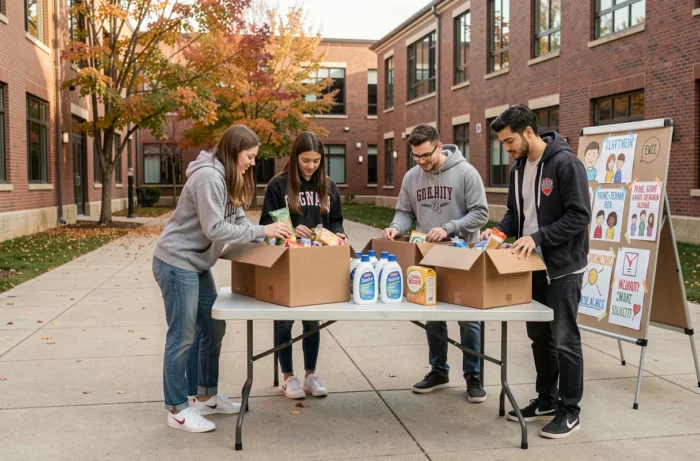
University schemes do not meet every need or reach every group. External associations help fill the gap by setting up regular support sessions directly on teaching sites. In Bourges, a branch of Secours populaire based at INSA offers food assistance and hygiene products once a month, as well as access to leisure and cultural activities.
Monthly support sessions have their limits. A student struggling to afford food on the 5th of the month cannot wait for a distribution scheduled for the 25th. How often support is available depends on the association’s logistical capacity, not on how urgently it is needed.
Recurring barriers
- Opening hours: distributions often take place during the day, when classes are in session, excluding students with packed schedules or those on placement
- Information: support schemes exist but are poorly signposted and scattered across CROUS websites, association pages and informal social media channels
- Continuity: a student-run solidarity grocery store may disappear the following year if no volunteers are available to take it over
Student activism and solidarity: what is changing in 2026
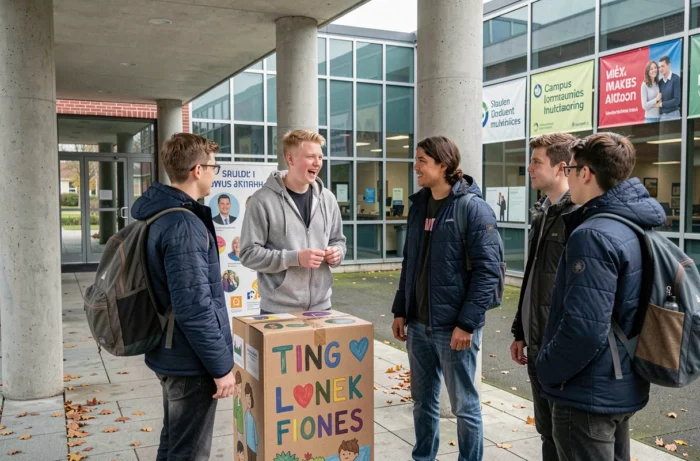
Recent protests have focused on more than tuition fees and education reforms. Food insecurity and access to healthcare have become reasons for campus occupations and petitions. At several universities, student groups have called for more funding for reduced-price meals, denouncing chronic underinvestment in university catering.
International students from outside the EU are among those most exposed to this systemic precarity. Differentiated tuition fees, limited access to need-based grants and administrative delays in obtaining residence permits: the obstacles pile up even before students face questions of housing or food.
Student associations remain the first line of support. Some solidarity grocery networks combine food assistance with social connection. They conduct a social assessment at intake, enabling individualised support but also creating another hurdle for students who are unfamiliar with administrative procedures.
Solidarity on campus advances in fits and starts, driven by local initiatives rather than a coherent national policy. As long as access to support depends on each student’s ability to find the right service, at the right time, with the right paperwork, the right to solidarity will remain an obstacle course for those who need it most.