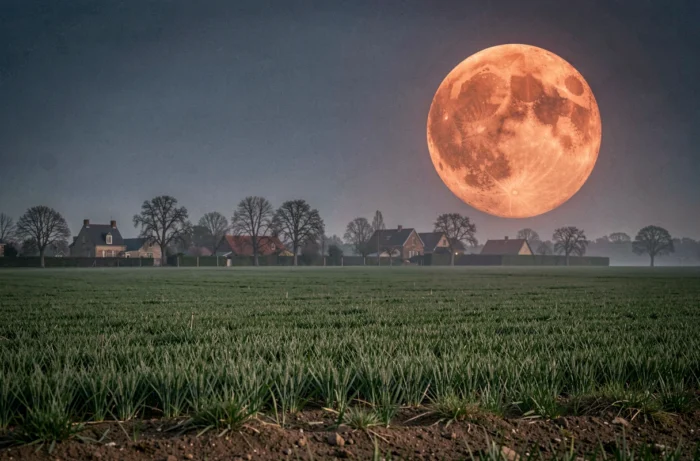
The red moon refers to the complete lunar phase that immediately follows Easter Sunday. It does not correspond to any particular coloration of the Moon, nor to a specific astronomical event. It is a marker of the lunar calendar inherited from agricultural traditions, signaling a period when late frosts still threaten spring crops.
Mechanism of nocturnal cooling during the red moon
The name “red moon” does not come from the celestial body itself, but from the state of the plants in the early morning. When the night sky is clear and the wind is light, the heat accumulated on the ground during the day dissipates quickly into the atmosphere. This phenomenon, called nocturnal infrared radiation, causes the temperature near the surface to drop well below what general forecasts indicate.
Young shoots, buds, and still tender leaves then suffer localized frost. At dawn, these plant tissues take on a brown hue, as if they had been “scorched” by fire. The Moon has no physical role in this, but its visibility in a cloudless sky precisely indicates the conditions that favor this cooling.
To check the dates of the red moon 2026 on Voyage 2 Rêve, this lunar phase occurs between mid-April and mid-May, a range where temperature differences between day and night remain significant in most French regions.
Dates of the red moon 2026: from April 17 to May 16
In 2026, Easter falls on April 5. The first new moon that follows occurs on Friday, April 17. This date marks the beginning of the red moon 2026. It ends at the next new moon, on Saturday, May 16, making for a lunar cycle of about 29 days.
The full moon of this lunar cycle occurs in early May. It is around this phase that clear nights are the brightest, and paradoxically the most conducive to radiation frost.
Overlap with the ice saints
The ice saints (May 11, 12, and 13) fall this year at the end of the red moon. This coincidence increases the risk for sensitive crops, as both traditional markers combine. Gardeners who wait for the end of the ice saints to transplant their tomato or zucchini plants have, this year, an additional reason to wait until mid-May.
Check the frost risk for your municipality: beyond the calendar
The red moon sets a period, not a certainty of frost. The risk depends on local weather conditions, altitude, land exposure, and proximity to a watercourse or an urban area that retains heat.
To concretely assess the danger on a given plot, several factors should be considered:
- The frost vigilance bulletins from Météo-France, which are issued at the departmental level and indicate risky nights a few days in advance.
- Observing the sky in the evening: a perfectly clear sky, combined with no wind or very light wind, meets the classic conditions for radiative frost.
- The topography of the garden: valley bottoms and depressions accumulate cold air by gravity, creating frost pockets even when neighboring plateaus remain safe.
- The nature of the soil: moist soil retains heat better than dry soil, which can limit the drop in temperature at the level of the plants.
A mini-max thermometer placed at the level of the crops, checked every morning during the lunar phase, provides a much more reliable picture than any general rule.

March 2026 lunar eclipse: a phenomenon distinct from the red moon
On March 3, 2026, a total lunar eclipse will give the Moon a coppery red hue during the totality phase. According to an article published by Clemson News, this totality lasts about 58 minutes. Confusion with the “red moon” is common, but the two phenomena are unrelated.
The eclipse results from the Moon passing into the Earth’s shadow. Sunlight, filtered and refracted by the Earth’s atmosphere, only allows red wavelengths to pass through, temporarily coloring the lunar disk. This optical mechanism occurs over a few hours, after which the Moon returns to its usual appearance.
Limited visibility from France
This March 2026 eclipse is not observable from all of France. Visibility conditions favor the west of North America, the Pacific, East Asia, and Australia. It is necessary to check the local time and the position of the Moon above the horizon before planning an observation evening.
A second lunar eclipse is scheduled later in 2026, but this one is partial. Its visibility also varies by region. Neither eclipse coincides with the lunar phase of the red moon, which occurs between April and May.
Red moon and gardening: separating tradition from the real mechanism
Tradition attributes to the Moon itself the power to “burn” young shoots. The real mechanism is strictly meteorological: it is the absence of cloud cover that causes the temperature drop, not lunar radiation. The Moon serves as a visual indicator, not a cause.
Protecting crops during this period relies on simple actions: winter covers placed at the end of the day, light watering of the soil in the evening to increase thermal inertia, delaying sensitive sowing until after mid-May. The date of May 16, 2026 marks the end of the red moon, coinciding with the exit from the traditional risk zone for most plain regions.
The lunar calendar remains a useful planning tool as long as it is supplemented by local observations. A lunar phase without frost occurs in some years, just as frosts can occur outside the red moon period. The marker helps to remain vigilant, not to predict.