
250 ml is equivalent to 25 cl. The rule is fixed: divide millilitres by 10 to get centilitres, regardless of the liquid being measured. This conversion is based on the metric system, where 1 centilitre contains exactly 10 millilitres and 1 litre is divided into 100 centilitres or 1,000 millilitres. Knowing how to apply this division helps prevent measuring errors in a recipe, but it doesn’t solve every kitchen measurement problem.
Volume and weight: why 25 cl doesn’t always weigh the same
Replacing 250 ml with 25 cl makes no difference to the volume. Both notations represent exactly the same amount of liquid. The formula is simply to divide by 10, and the result is the same for water, milk, oil or vinegar.
The problem arises when a recipe mixes measurements in millilitres and grams. Converting volume to weight requires knowing the ingredient’s density. Water has a density close to 1, so 250 ml of water weighs about 250 g. Whole milk is slightly denser, so 250 ml weighs a little more than 250 g. Olive oil is less dense, so the same volume weighs less than water.
With honey, the difference becomes significant: its high density means that 250 ml of honey weighs considerably more than 250 g. If a recipe calls for 250 g of honey and you measure it by pouring 25 cl into a measuring jug, the result will be off. When a recipe calls for 250 ml of milk in centilitres, the direct conversion works because milk is a liquid with a density close to that of water.
Converting ml to cl: the method to remember for any volume
The formula takes just one step: divide the value in millilitres by 10. It works for any amount, not just 250.
- 100 ml = 10 cl, which is also 1 dl (decilitre), a unit commonly used in Swiss recipes and some older French recipes.
- 150 ml = 15 cl, a common amount for sauces or stock added during cooking.
- 250 ml = 25 cl, or a quarter of a litre—the most commonly requested amount in baking recipes for milk or cream.
- 500 ml = 50 cl, or half a litre, typically the capacity of a small bottle of water.
To convert the other way, multiply centilitres by 10 to get millilitres. There’s no need for a chart once you understand the principle: just move the decimal point one place.
Which marking to read on a measuring jug
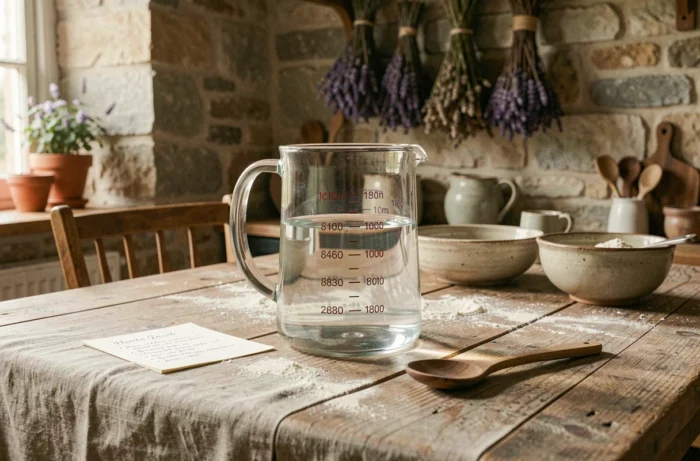
Most kitchen measuring jugs show both millilitres and centilitres in two parallel columns. Some older models only show ml. In that case, the 250 ml line is the same as 25 cl, so there’s no need to calculate.
Cheap plastic measuring jugs become harder to read over time as the markings fade in the dishwasher. A borosilicate glass model keeps its markings for longer and is more resistant to thermal shock.
Recipes measured by volume or weight: when to use scales instead of a measuring jug
Converting ml to cl is straightforward for liquids. Measurements become less precise when dry ingredients are measured by volume.
Flour packed into a measuring jug doesn’t weigh the same as flour poured in loosely. Two 250 ml measures of flour can have very different weights depending on how the jug was filled. In baking, where a difference of just a few grams can change the texture of a batter, scales are more reliable than a measuring jug for powders.
The simple rule: for liquids (water, milk, single cream, oil, juice), converting between ml and cl is always exact. For solids and thick pastes (flour, icing sugar, peanut butter, honey), weighing the ingredient on scales gives a consistent result.
The special case of Anglo-Saxon recipes
“Cup” measurements don’t have a single value across countries. A US cup holds about 237 ml, a metric cup (used in Australia) holds 250 ml, and a Japanese cup is different again. When a recipe translated from English calls for “1 cup”, check the original measurement system to avoid using the wrong amount, even if you convert from ml to cl correctly afterwards.
Converting 1 US cup to centilitres gives about 23.7 cl, not 25 cl. The difference may seem small for a glass of milk, but it adds up in a recipe that calls for several cups of liquid.

Online conversion tools: reliability and limitations
Many online converters can instantly convert millilitres to centilitres, decilitres or litres. For volume-to-volume conversions, the result is always accurate: it’s a simple division.
The problem arises when these tools also offer a conversion to grams. A converter that applies a generic density gives an estimate, not a reliable measurement. If the tool doesn’t ask you to specify the ingredient, the gram value it displays implicitly assumes the density of water. For milk, the difference is acceptable. For flour or maple syrup, the result can be misleading.
Before using a volume-to-weight conversion, checking that the tool specifies the ingredient and the density assumption it uses is the only way to ensure a reliable result.
Summary of equivalents for 250 ml
| Unit | Value |
|---|---|
| Millilitres (ml) | 250 |
| Centilitres (cl) | 25 |
| Decilitres (dl) | 2.5 |
| Litres (l) | 0.25 |
This table covers volume conversions. To get a weight in grams, you always need to know the ingredient. 250 ml of water weighs about 250 g, but that figure doesn’t apply to honey, oil or flour. The distinction between volume and weight is the key thing to remember whenever a recipe uses both types of measurement.