Southwest France attracts cyclists every year with its canals, vineyards and greenways. Renting a bike locally seems like the obvious solution, and in most cases, it is. But between one-way routes, temporarily diverted cycle routes and choosing the right type of bike, renting only makes the trip easier if you know what it actually solves.
One-way trips in Southwest France: the logistical problem bike rental solves
Have you ever tried travelling by train with your own bike between Bordeaux and Toulouse? Dedicated spaces are scarce, sometimes require reservations, and a bulky bike makes every connection more complicated. Renting a bike eliminates that hassle in one go.
Some rental companies in Southwest France offer bike delivery to your starting point and collection at your destination, as well as phone support in case of mechanical trouble. This lets you plan a one-way route, from the Canal des Deux Mers to Carcassonne, for example, without worrying about getting back. These services aren’t automatic: they depend on each provider’s terms, so it’s best to check before booking.
The idea of renting a bike to explore Southwest France makes perfect sense when you compare it with the alternative: dismantling your own bike, packing it, paying an extra baggage fee, then doing it all again on the way back. For a week-long stay, renting often costs less than two round trips with a bike travel bag.
Cycle route diversions and roadworks: adjust your route before setting off
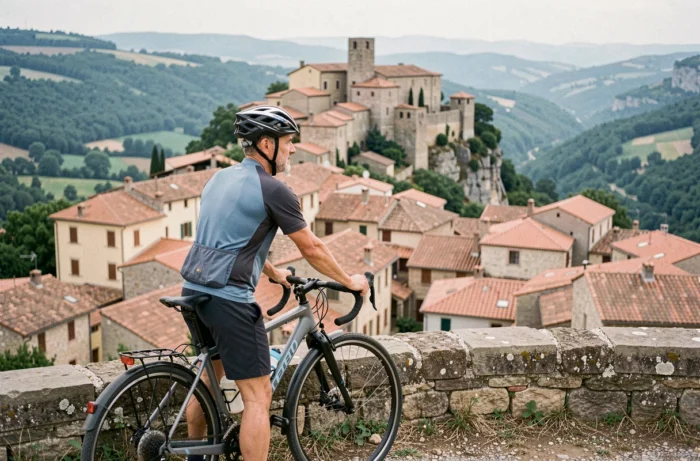
Cycle routes in Southwest France are not set in stone. In April 2026, the La Rochelle urban area reported roadworks in Aytré and a diversion on the Vélodyssée, including measures to make level-crossing approaches safer. These kinds of temporary changes are common on a growing network.
With your own bike, you discover the diversion when you get there and have to improvise. With a local rental company, notices about closed sections are often included in the route information provided at the start. Some even adjust their suggested routes to account for ongoing roadworks.
This is an advantage that’s rarely mentioned. A rental company’s local knowledge turns a potential obstacle into a simple alternative route. On the Vélodyssée or the Canal du Midi, where towpath sections can be closed for several weeks, having this information in advance can make all the difference to your trip.
Electric or standard bike: choosing the right type for your route
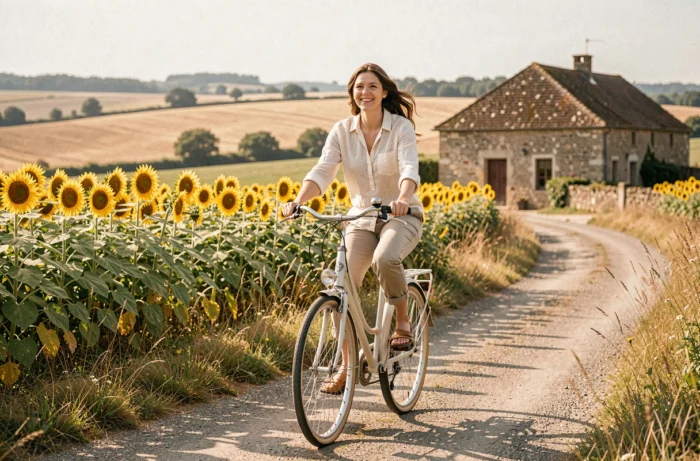
The Canal du Midi follows a flat, shaded towpath. The Entre-deux-Mers, by contrast, winds through hills and valleys. Renting lets you choose a bike suited to the terrain ahead, without having to own several bikes.
On the Roger-Lapébie trail, a former railway line that crosses the Entre-deux-Mers from Bordeaux, rental companies also offer tandems, cargo bikes, tricycles and handcycles. This variety makes the trip accessible to a wide range of people: families with young children, people with reduced mobility and occasional cyclists.
An electric bike comes into its own on longer stages or in hot weather. You can ride the Canal du Midi in short sections or complete stages, and electric assistance lets you adjust your effort without cutting the distance short. Here are the factors to consider when choosing:
- Route terrain: flat along the canals, hilly in the Bordeaux countryside or the foothills of the Pyrenees. An electric bike becomes a real comfort as the elevation gain adds up.
- Stage length: beyond 40 to 50 kilometres a day, assistance reduces fatigue and leaves you with energy for sightseeing.
- Group make-up: a tandem or cargo bike can bridge the difference in ability between adults and children, so no one has to slow the group down.
- Weather conditions: summer temperatures in Southwest France rise quickly. An electric bike lets you set off earlier in the morning and cover the distance before the hottest part of the day.
Hot weather and shaded canals: planning your stages in Southwest France
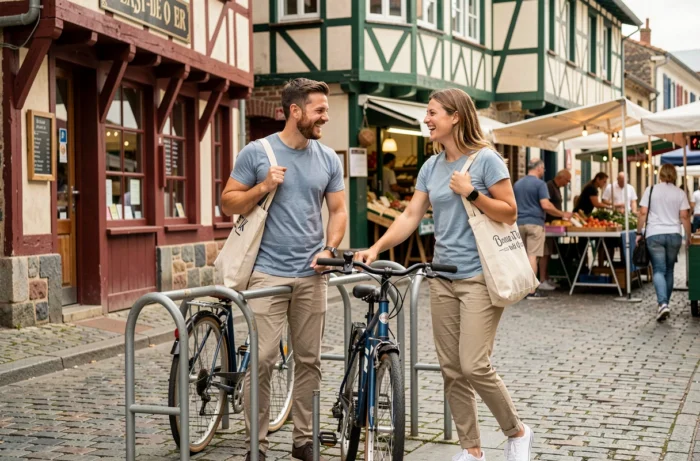
The season matters just as much as the distance. In July and August, temperatures in the Lauragais or the Garonne Valley regularly rise above comfortable levels for cycling in the middle of the day.
Bike touring guides recommend, during hot spells, making the most of cooler hours and shaded routes along the canals. The Canal du Midi towpath, lined with plane trees along much of its route, offers natural protection from the sun. Open routes, such as some sections through vineyards, call for greater caution.
Renting gives you the flexibility to adjust your plans. You can shorten a planned stage and split it into two half-days, pick up the bike later or change your overnight stop. This kind of flexibility is hard to achieve when travelling with your own equipment and a fixed itinerary.
Combine cycling and heritage without rushing
Southwest France is home to listed heritage sites just a few dozen kilometres apart. Bordeaux, a UNESCO World Heritage Site, is a day’s ride from Saint-Émilion. The Canal des Deux Mers connects two coastlines, passing through vineyards and medieval fortified towns.
Cycling sets a pace that suits the region’s network of heritage sites. You cover enough ground to see a different landscape each day, but not so much that you rush past everything. It’s a happy medium between driving (too fast to stop) and walking (too slow to connect the stages).
Renting a bike in Southwest France works well, as long as you treat it as a logistical choice rather than just a convenience. Check delivery and collection services, look for diversion notices on cycle routes, and choose a bike to suit the terrain and weather: these are the details that turn a good idea into a successful trip.