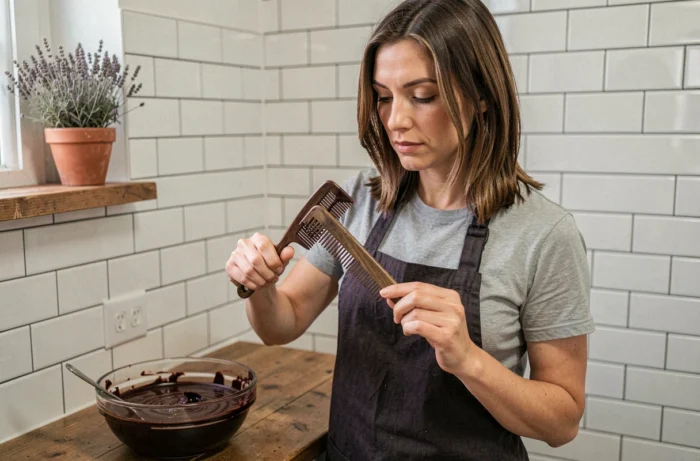
On a light brown base, a henna-indigo mixture applied without prior testing often turns coppery or greenish, far from the desired natural brown. The problem does not come from the plants themselves, but from how the pigments are dosed, layered, and allowed to oxidize. For those wanting to dye their hair or textiles with plant dyes, brown remains a demanding color because it always results from a balance between several pigments.
Plant pigments and plant mixtures for a stable brown
Brown does not exist as a single pigment in the plant world. It is obtained by combining orange molecules (lawsone from henna), blue (indigo), and sometimes yellow or tannic (walnut husk, oak bark). Each plant brings its dominant color, and it is the proportion of the mixture that determines the final shade.
For hair coloring, the henna-indigo duo is the basis of almost all plant-based browns. Henna alone gives a coppery color. Indigo alone, on unpigmented hair, produces a dull blue-gray. When combined in the right proportions, they cover a spectrum ranging from golden brown to deep brown.
On textiles, the logic is the same but the plants change. We work with barks (walnut, chestnut), roots (madder for the red component), and leaves (woad for the blue). The fabric must be made of natural fibers (cotton, linen, wool) for the pigments to properly penetrate the fibers. When seeking to achieve a natural brown shade on a textile, the prior mordanting conditions the result as much as the choice of plant.
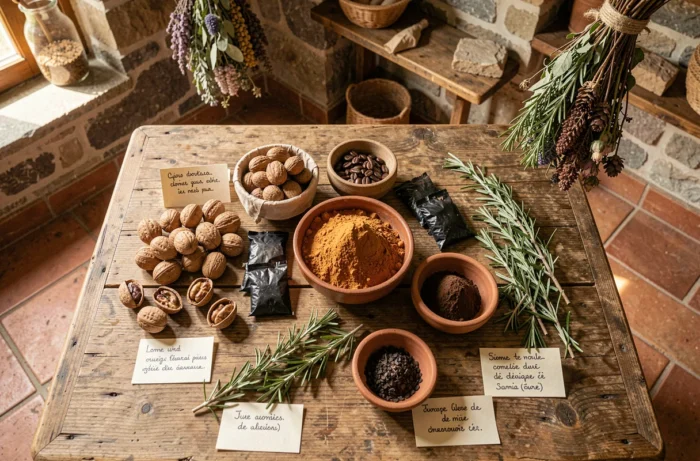
Mordanting and preparing the substrate before plant dyeing
Applying a dye bath on an unprepared fabric means losing half the color after the first wash. Mordanting fixes the pigments in the fiber by creating a chemical bond between the dye molecule and the textile.
Common mordants for natural fibers
- Alum (aluminum and potassium sulfate): the most commonly used mordant in plant dyeing. It does not alter the shade and is suitable for both cotton and wool. It is used in a warm bath before dyeing.
- Iron sulfate: it darkens and cools the color. Added at the end of the bath, it shifts a reddish-brown to a chocolate brown. To be dosed carefully, as an excess can stiffen the fibers.
- Tannins (gall nuts, oak bark): they serve both as a pre-mordant on cotton and as a color source. On a tanned base, the madder bath gives a warm brown rather than a bright red.
For hair, mordanting does not exist in the textile sense. Pre-pigmentation with henna plays a comparable role: it deposits an orange layer onto which the indigo will adhere to produce brown. Without this step, indigo slides over light or white hair, and the result lacks depth.
Henna-indigo dosing for brown hair coloring
The proportion between henna and indigo determines everything. The more henna is increased, the warmer the brown becomes. The more indigo is increased, the cooler it turns, even to black.
A common starting point for a medium brown: two-thirds henna to one-third indigo. For a chocolate brown, the ratio is almost reversed. Each hair type reacts differently depending on its porosity and starting color, which makes testing on a hidden strand non-negotiable before a full application.
One-step or two-step application
The two-step method (henna first, then indigo, over two days) generally yields a richer and more homogeneous brown than a single mix. Henna needs a slightly acidic environment to release its lawsone, while indigo works better in a neutral environment. Mixing the two in the same bowl creates a pH compromise that can hinder one or the other pigment.
On the other hand, the one-step method is quicker and sufficient for already dark hair that mainly needs highlights. On white hair, the two-step method remains the most reliable to avoid isolated coppery strands in the brown.
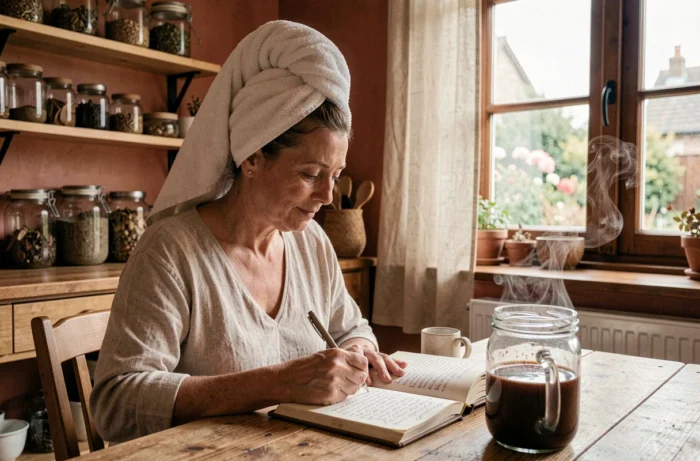
Oxidation and stabilization of the brown shade after application
Rinsing the dye and judging the result immediately is a common mistake. Plant pigments continue to oxidize after rinsing: the color can evolve significantly over the next 24 to 48 hours. A brown that appears too light when coming out of the shower can darken by one or two shades in two days.
For textiles, the same phenomenon occurs with indigo. The fabric comes out of the bath in greenish tones that turn deep blue in the air, and the mixture with the warm component (madder, walnut husk) does not stabilize until after complete drying and sometimes an additional rinse.
What causes variation in results from one test to another
The final shade depends on the hardness of the water (hard water can dull the pigments), the temperature of the bath, the time of exposure, and the freshness of the powders. Powders stored for more than a year lose dyeing intensity. On hair, porosity varies depending on previous treatments, which explains why the same mixture gives a golden brown on one person and a matte brown on another.
A final pitfall concerns later transitioning to chemical coloring. Indigo deposited on the hair can produce greenish highlights during bleaching. Before any change in technique, a strand test and clear information to the hairdresser about previous plant colorings can avoid costly surprises to correct.
Plant brown is built up in layers, through trials and patience. Keeping a dosage notebook (proportions, exposure times, results at D+2) remains the safest way to reproduce a shade we like, whether on hair or on a piece of linen.