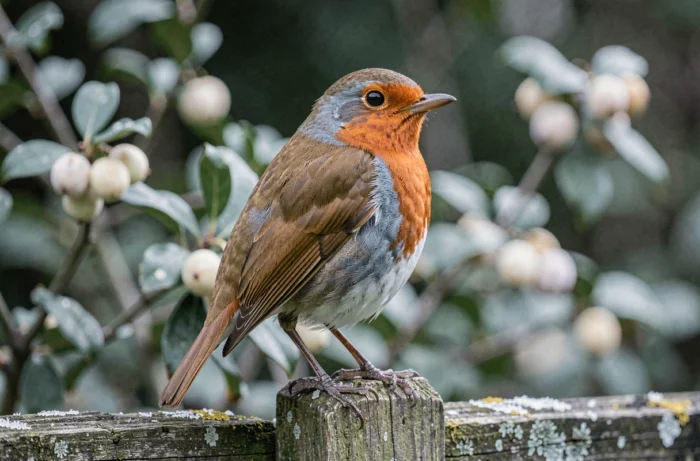
A robin lands on the spade stuck in the vegetable patch, less than a metre away from you, and stays there for several seconds. The scene repeats over several days. Before reading a spiritual sign into it, you might ask what is actually drawing this bird closer, and when an ordinary encounter becomes a personally meaningful experience.
Robin behaviour in winter: what explains its closeness
The first thing to understand is that the robin following you around the garden isn’t attracted to you in particular. Turning over the soil uncovers prey (worms, larvae, insects), and the bird is simply taking advantage of this easy food source. Naturalists’ observations also link winter territories to the proximity of shelter from predators, such as an enclosed garden, a dense hedge or a south-facing wall.
People often associate the robin’s winter song with melancholy or a call. In reality, both sexes sing to defend a food territory, including females. So the autumn and winter song isn’t about courtship: it tells any rival that the area is occupied.
A study conducted in a garden in the north of the Netherlands between 1993 and 2021 found that the date of the first autumn song tended to move earlier over the years.
The authors suggest that breeding and moulting seasons are starting earlier, while noting that observations from a single site cannot support a general conclusion. What we can take from this is that the robin’s seasonal calendar is changing, and that it is appearing in our gardens earlier in autumn.
Experiments using loudspeakers to play bird songs confirmed that both males and females increased their vocalisations in response to a recorded intruder, regardless of the sex of the bird in the recording. This territorial reflex can make it seem as though the bird is “responding” to our presence, when it is simply defending its territory.
Exploring the spiritual meaning of the robin makes more sense once these natural behaviours are understood: we can then distinguish instinct from what may go beyond a biological explanation.
The spiritual meaning of the robin: beliefs that have endured through the centuries
In many European traditions, the robin is associated with the dead and messages from the afterlife. Its bright red breast has inspired Christian legends: the bird was said to have scorched its feathers while trying to remove a thorn from Christ’s crown, or while fanning the embers of a fire to warm the infant Jesus.
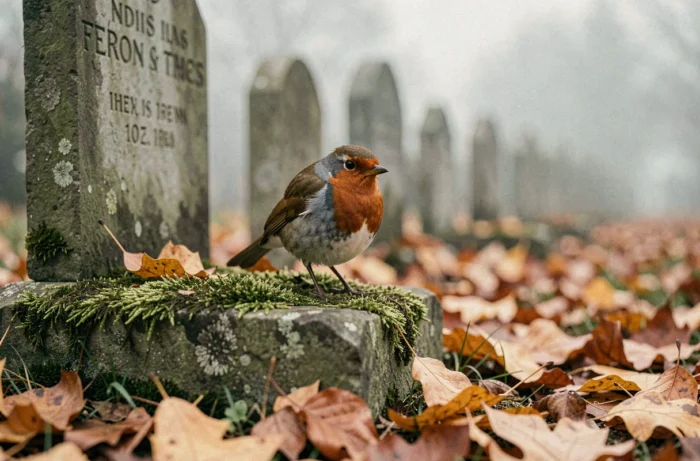
This symbolic significance has led people to see it as a messenger between the world of the living and the world of the dead. In the British Isles, seeing a robin on a grave or near a window during a period of mourning is interpreted as a visit from a loved one who has passed away. In France, the belief is most common in rural areas, where the bird remains visible all year round, unlike migratory birds.
What signs draw people’s attention
People who attach spiritual significance to an encounter often describe a combination of specific circumstances:
- The bird appears during a time of sadness or introspection, or on a significant date (a death anniversary, a family celebration).
- It behaves unusually for a wild animal: it stays still, comes very close or returns to the same spot several times.
- The encounter triggers an emotional response that seems disproportionate to how ordinary the scene appears.
It is the combination of the emotional context and the unusual behaviour that turns an observation into an experience perceived as a sign. A robin pecking at crumbs on the patio on an ordinary Tuesday morning doesn’t prompt the same reaction.
Robins and messages from the afterlife: distinguishing a sign from a natural reflex
There is no definitive answer to this question, and that isn’t the point. What varies from person to person is the point at which an encounter with a robin shifts from being anecdotal to feeling personal.
One useful question to ask is: does the bird’s behaviour fall outside its usual territorial patterns? A robin perched on a spade in a freshly dug vegetable patch is following a typical feeding pattern. The same bird tapping on a closed window, entering a room or landing on the hand of someone who is grieving is behaving unusually, even from an ornithologist’s perspective.
What science cannot explain
Behavioural biology describes the mechanisms behind territoriality, feeding and song. It is not intended to invalidate a deeply personal experience. The meaning we attach to an encounter belongs to a different realm: that of personal resonance.
A simple guide to keep in mind:
- Neutral context and typical feeding behaviour: probably a territorial reflex.
- Strong emotional context and unusual behaviour from the bird: the encounter can reasonably be experienced as a message.
- Unusual repetition over several days, in the same place and under the same circumstances: this is the pattern most often described in accounts with a spiritual dimension.
Robins in the garden: welcome the bird and stay observant
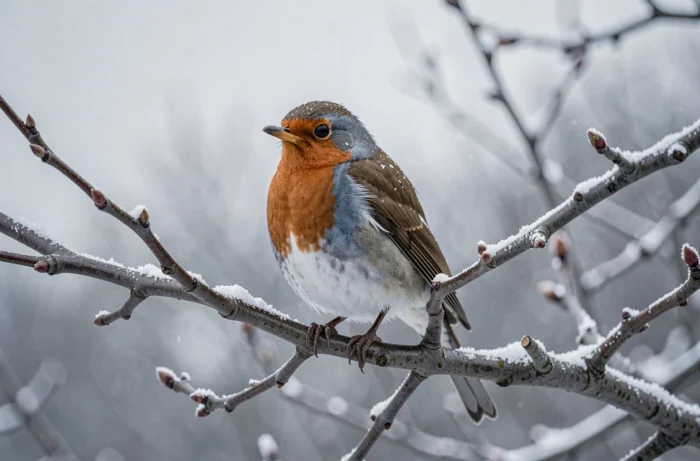
Whether you’re looking for a sign or simply enjoy the company of a charming songbird, a few practical steps can encourage it to visit. A water source that’s accessible all year round, even a simple container placed on the ground, attracts robins far more than seeds do. Leaving a patch of the garden unmown and covered with fallen leaves provides a ready supply of invertebrates.
Avoid using insecticides in areas where you hope to see robins: in autumn and winter, robins feed almost exclusively on small live prey. Treated soil is an empty food source for them.
Robins don’t need a mystical role to be worth taking an interest in. Their familiarity, winter song and distinctive plumage make them one of the few wild birds we can observe from just a few centimetres away. Whether this closeness is a message or a biological coincidence, it is remarkable either way.