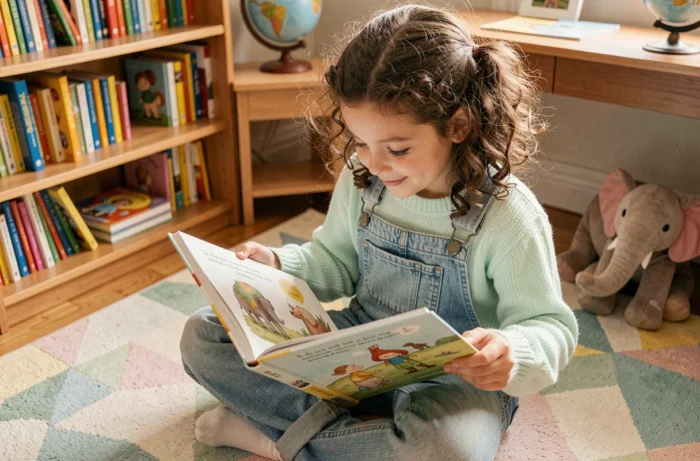
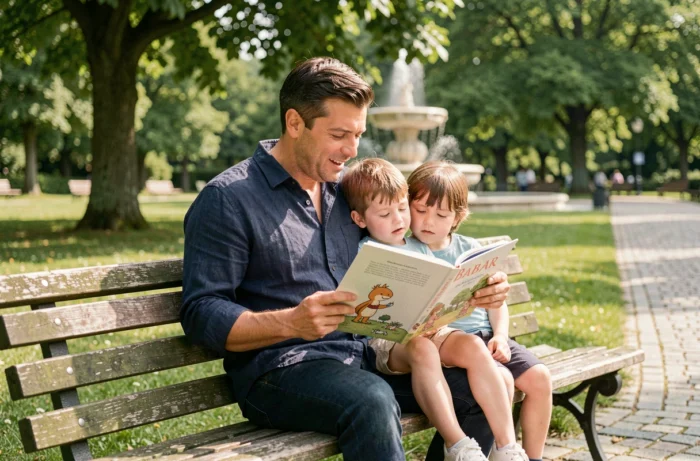
When you open Le Voyage de Babar with a four-year-old, the first question often comes as soon as you reach the double-page spread with the balloon: “Where’s that?” Jean de Brunhoff’s book, published by Hachette, places the little elephant in settings that blend real-world geography with pure invention. That very ambiguity makes it a rich reading resource, as long as you know how to make the most of it.
Original Babar watercolors: what children can see in person
Before discussing the books available in bookstores, one detail is worth mentioning. The BnF Museum at the Richelieu site holds a 1932 watercolor by Jean de Brunhoff illustrating a shipwreck scene from Le Voyage de Babar. This is not a reproduction: it is the original drawing, with its faded colors and pencil lines visible beneath the paint.
For a child who has just read the scene in the book, seeing the original watercolor gives the drawing a physical presence. It becomes more than a printed image: it is a museum object, with its own size, frame, and lighting. This is a tangible way to explain the difference between an original and a copy.
Resources about the world of Babar, including educational activities and reading suggestions, can be found at https://www.babarautourdumonde.fr, which brings together content for families.
In Babar’s Museum of Art, Babar and Céleste turn an abandoned train station in Célesteville into a museum to display works collected during their travels. This offers a direct educational thread: the characters do exactly what real museums do—collect and display.
Imaginary and real places in the Babar books: learning to tell them apart
Célesteville does not appear on any map. Paris, on the other hand, features from the very first book. Le Voyage de Babar moves between the two without warning, which makes it an interesting read to share with a child.
Spotting clues in the illustrations
Jean de Brunhoff draws Paris with recognizable details: Haussmann-style façades, the opera house, and department stores. Children who know Paris recognize these features without needing them pointed out. For others, an open atlas beside the book is all it takes.
Célesteville, by contrast, is recognizable by the lack of any precise geographical reference. Its buildings resemble those of an ideal city, with proportions suited to elephants. You can ask your child, “Does this city exist somewhere?” The answer usually comes quickly.
Turn reading into a sorting game
A fun activity for children aged five and up is to sort, page by page, what is real and what is made up. You can use two piles of sticky notes, or simply point things out.
- Babar’s clothes (his green suit and crown) are imaginary, but similar costumes can be found in fashion museum displays
- The balloon Babar and Céleste travel in is reminiscent of hot-air balloons, which you can see in a science museum or at festivals
- The shipwreck shown in the 1932 watercolor brings real maritime stories to mind, and children can then look up images of famous shipwrecks in an encyclopedia
Sorting out what is real and what is imaginary builds critical reading skills that children can use with other books, too.
Extend Babar’s journey with real-world visits
One of the strengths of the Babar series for families is that it opens the door to real places. You don’t have to travel far to turn reading into an outing.
Museums and historic libraries
The Bibliothèques de Paris catalog lists several original editions in the series, including Le Voyage de Babar. Looking through an old book in a library, with its hardback cover and yellowed pages, gives the story a different weight. Children get to touch an object that is several decades old.
The BnF’s illustration collections offer even more to explore. Showing children the original watercolor after reading the book creates a direct link between fiction and cultural heritage. They understand that someone painted the scene by hand, using paint and water.
Atlas and globe
After reading, you can trace Babar’s supposed route on a globe. Where might Célesteville be? In Africa, judging by the plants in the illustrations. Where does the balloon set off from? Which ocean is the shipwreck in?
A globe turns a story into a geography activity without making children feel as though they’re learning. You can name continents, oceans, and compass directions—all through play.
Choosing the right Babar book for your child’s age
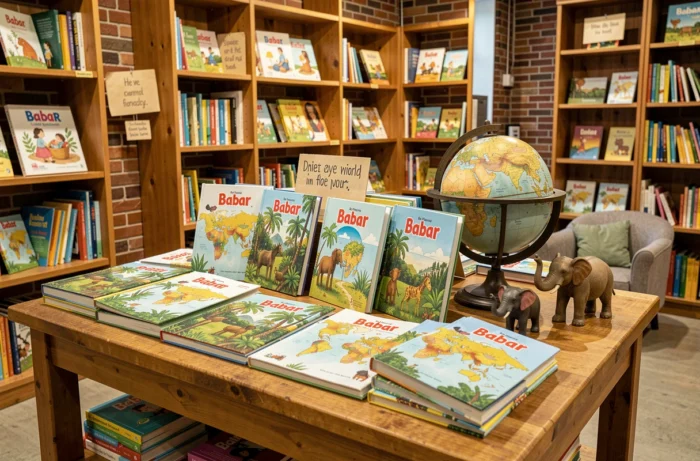
Not all the books in the series are equally suited to exploring the theme of travel. Jean de Brunhoff’s text is denser than that of his son Laurent, who continued the series. The sentences are long, and the vocabulary is sophisticated.
- For three- and four-year-olds, shorter books with large illustrations work best when read together, with an adult rephrasing the text as they go
- From age five, Le Voyage de Babar can be read in full over several sessions, giving you time to revisit the places and ask questions between readings
- Babar’s Museum of Art is a good fit for slightly older children who are beginning to understand the idea of exhibitions and collections
- Animated adaptations offer another way in, but they simplify the settings and lose the richness of the original watercolors
The choice also depends on what you want to do after reading. If you’re planning a museum visit, it’s best to start with a book whose illustrations are detailed enough to compare with real works of art.
Jean de Brunhoff’s books are still the best suited to this kind of approach. His watercolors pay close attention to the settings, a quality that later versions have not always retained. A child who studies these illustrations closely develops, without realizing it, the habit of looking carefully at images—a skill that will serve them well beyond children’s literature.