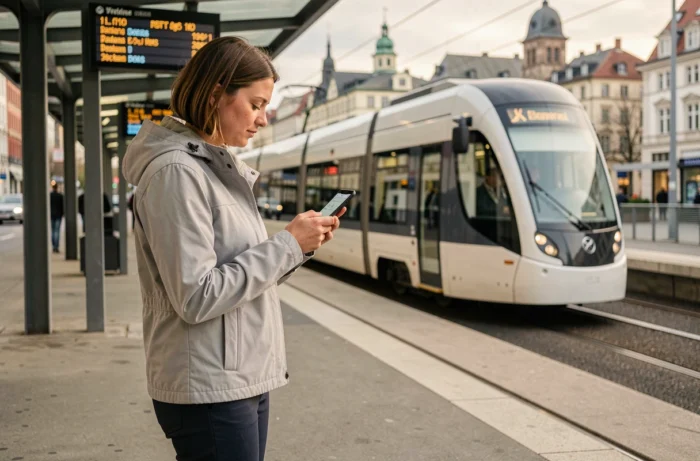
Mobility authorities (AOMs) are now rolling out shared mobility services on a large scale: carpooling, bike sharing and car sharing. The problem lies further down the line: these services remain poorly connected to multimodal information systems and public transport fare structures. Passengers have to piece together their journeys themselves, one service at a time.
Integrated fares and multimodal data: the missing link
Shared mobility services are multiplying, but back-office systems are failing to keep pace. Gart points to a structural flaw: shared services are not integrated into public transport information systems or fare structures. In practice, a resident of the outer suburbs combining a regional train, an urban bus and bike sharing has to juggle three apps, three accounts and three separate payments.
The transport section on L’Actu Auto regularly covers the regulatory and industry developments that shape how smoothly multimodal journeys work.
The issue goes beyond convenience. Without interoperable real-time availability data—carpooling seats, bikes at stations and feeder service schedules—no journey planner can offer a reliable end-to-end trip. MaaS (Mobility as a Service) platforms exist, but they run up against barriers to accessing each operator’s data feeds, which are often protected by contractual clauses or proprietary formats.
The European legislative proposal on multimodal booking addresses this issue. It sets out rules on offer transparency and the sharing of certain data between operators. At this stage, the text remains a proposal, not a rule in force. Its adoption would nevertheless determine whether AOMs can create combined passes covering several modes of transport under a single ticket.
Urban outskirts: new mobility options that don’t simplify everything
New mobility options add choices without reducing the coordination burden for suburban passengers. In city centres, services are plentiful and distances between modes are short. On the outskirts, the last mile remains the bottleneck.
Demand-responsive transport (DRT) is gaining ground in local projects. DRT tenders are on the rise, while bike-sharing tenders are declining. This contrast reflects a reality on the ground: in sparsely populated areas, a shared vehicle booked on demand is better suited to dispersed travel patterns than an underused bike station.
Local authorities are gathering more data on travel beyond major urban centres, but results take time. Mobility surveys are being launched in several mid-sized urban areas to capture actual travel habits, particularly in outlying municipalities. Without this local data, mobility plans remain modelled on dense urban areas that do not reflect how people actually live and travel.
What DRT changes (and what it doesn’t)
Demand-responsive transport removes the constraints of fixed schedules and predefined routes. It works well for feeder journeys to a railway station or transport hub. Its limitations become clear when demand peaks during rush hour: the service reaches capacity, pickup times increase, and passengers fall back on their own vehicles.
- DRT advantage: coverage for areas not served by regular routes, at a lower operating cost than a fixed route with low ridership
- Main limitation: insufficient capacity to scale up during peak hours, pushing passengers towards private cars precisely when congestion is at its worst
- Key consideration: DRT quality depends on the ride-optimisation algorithm and fleet size—two factors that AOMs do not always control directly
Cycling and bike sharing: two distinct trends
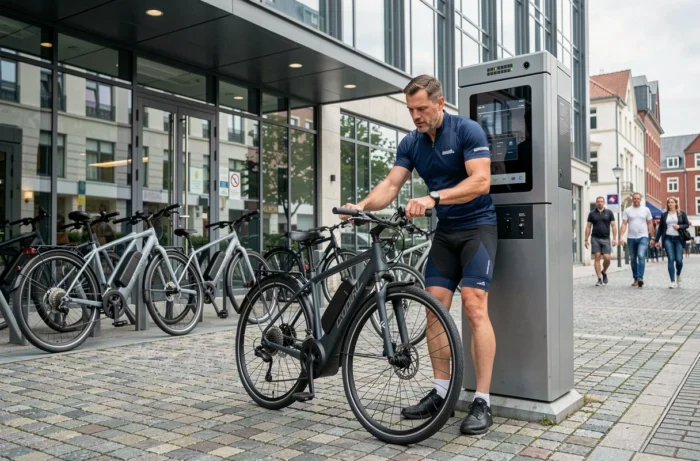
It is a common mistake to conflate the rise in cycling with the performance of bike-sharing services. In Paris, cycling volumes increased in 2025 compared with 2024, but Vélib’ rentals fell over the same period, while rentals from bike-sharing services other than Vélib’ rose.
This divergence suggests that everyday cycling is driven mainly by personal bike purchases—particularly e-bikes—and competing fleets, rather than by the established service alone. This makes planning more complex for AOMs: investing in cycling infrastructure remains worthwhile, but subsidising a single bike-sharing operator does not guarantee a share of the growth in cycling.
Infrastructure versus services
Protected bike lanes generate cycling traffic regardless of the bike-sharing operator. Infrastructure creates demand; services capture only part of it. Cities that invested in their physical networks before signing bike-sharing contracts are seeing faster, more resilient adoption.

Local mobility data: an underestimated prerequisite
Household travel surveys require substantial budgets, and their results are not available immediately. The time lag between data collection and analysis creates a blind spot for local authorities seeking to adapt their services.
Meanwhile, private operators (ride-hailing, e-scooters and car sharing) are accumulating real-time travel data that they share only to a limited extent. The information imbalance between private operators and local authorities is hampering the adaptation of public services. The European proposal on multimodal data sharing could help rebalance the situation, provided it is adopted and transposed into national law.
Current transport trends point to a landscape in which services are diversifying faster than coordination tools can keep up. For people living on the outskirts, a growing number of services is only useful if a single ticket, a reliable journey planner and open data make it possible to combine them seamlessly. This less visible challenge—not the launch of yet another app—is where the real transformation of everyday travel will take place.