
Code P0303 indicates a misfire detected in engine cylinder 3. On a Renault, this fault may be caused by ignition components, the fuel supply system, or an internal mechanical problem. Identifying the exact source requires a systematic diagnostic approach, because the code identifies the affected cylinder, not the faulty part.
P0303 on a Renault with LPG: a frequently overlooked diagnostic step
On Renault vehicles that run on both petrol and LPG, the first step is to note which fuel mode the engine is using when the misfire occurs. If P0303 only appears in LPG mode, the gas injector for cylinder 3 and its calibration should be the first things to check.
A clogged or incorrectly calibrated LPG injector can cause a lean mixture in a single cylinder, resulting in an intermittent misfire. However, if the fault also occurs when running on petrol, the dual-fuel system is no longer the likely cause, and checks should focus on the ignition system or conventional fuel injection.
This simple distinction can help you avoid replacing a coil or spark plug unnecessarily. Before carrying out any work, it is worth learning how to fix code P0303 on a Renault by following a structured approach suited to the engine type.
| Symptom observed | LPG mode only | Petrol and LPG modes |
|---|---|---|
| Cylinder 3 misfire | LPG injector, gas calibration | Ignition coil, spark plug, petrol injector |
| Flashing engine warning light | Catalytic converter risk, reduce engine load | Catalytic converter risk, stop recommended |
| Steady engine warning light | Have it diagnosed within a few days | Have it diagnosed within a few days |
| Code disappears after clearing | Check over several LPG trips | Check over several petrol trips |
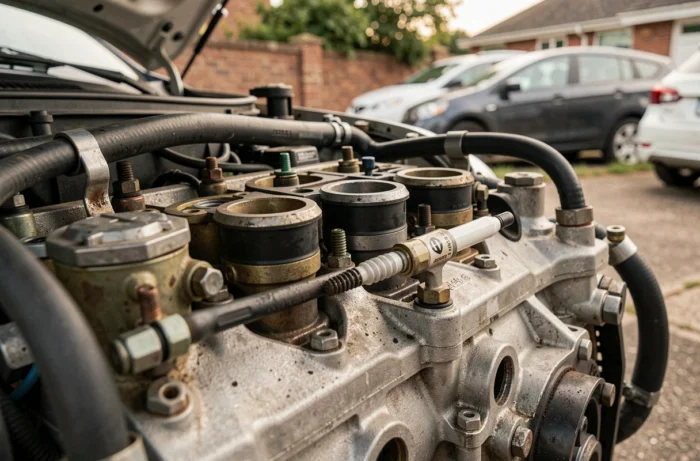
Swap test to isolate the fault on cylinder 3
P0303 identifies the cylinder where the engine control unit detects a misfire, not the part responsible. Moving the ignition coil from cylinder 3 to another cylinder is the most reliable way to determine whether the coil is faulty or the problem lies elsewhere in the cylinder.
If the code moves to the new cylinder after the swap (for example, P0301 or P0302), the coil is at fault. If the code remains on cylinder 3, the coil is ruled out and further checks are needed.
Apply the same logic to the spark plugs
The same swap test can be used for the spark plugs. A worn plug or one with an electrode gap outside the specified tolerance can cause a localized misfire. Swapping the cylinder 3 plug with one from a cylinder that is working properly shows whether the fault follows the part.
On Renault engines with limited access (some 1.2 TCe configurations, for example), this job requires removing the intake manifold. Labour often accounts for the largest share of the cost, making an accurate diagnosis before disassembly all the more important.
Steady or flashing engine warning light: two different levels of severity
OBD standards define two engine warning light behaviours in response to misfires. A steady light indicates a stored fault, but the misfire rate is below the threshold that poses a risk to the catalytic converter. A flashing light, on the other hand, indicates that the misfires have reached a level that could damage the catalytic converter.
If the light flashes, the instruction is clear: immediately reduce engine load and speed, then stop if the shaking continues. Unburned fuel reaching the catalytic converter can cause it to overheat and fail within minutes under full load.
Why clearing the code without repairing the fault solves nothing
Clearing P0303 with an OBD scanner turns off the warning light, but does not remove the underlying cause. The engine control unit resumes monitoring on subsequent trips. If the misfire continues, the code will return, sometimes accompanied by P0300 (random misfires across multiple cylinders) if the problem gets worse.
Clearing the code before an inspection does not hide the fault: an emissions test can reveal irregular combustion, and the inspector may flag the absence of stored codes after a recent reset.

Mechanical causes of P0303: compression and cylinder 3 sealing
If swapping the coil and spark plug does not move the code, mechanical causes move up the diagnostic checklist. A compression test on cylinder 3, compared with the other cylinders, provides an initial indication.
- A degraded head gasket between cylinder 3 and a coolant passage causes localized compression loss, often accompanied by white smoke from the exhaust.
- A valve that no longer closes properly (due to deposits or valve clearance outside tolerance) reduces the seal of cylinder 3’s combustion chamber.
- A faulty petrol injector that no longer sprays fuel correctly creates an uneven mixture, causing a misfire even if the ignition system is working normally.
On Renault direct-injection engines, carbon deposits on the intake valves are a common cause of localized misfires. Fuel injected directly into the combustion chamber no longer cleans the valves, unlike with port injection.
Recommended inspection order
- Swap the cylinder 3 coil with one from another cylinder, then read the code after a drive.
- Swap the spark plug if the coil is not at fault.
- Check the injector (flow rate, spray pattern, electrical resistance).
- Compare compression across all four cylinders.
- Visually inspect the valves with a borescope if compression is low.
Each step rules out one possibility before moving on to the next. Replacing several parts at once makes it impossible to know which one was actually at fault and increases the bill without guaranteeing a fix.
P0303 identifies a location; it is not a verdict. The swap-test method, combined with distinguishing between LPG and petrol operation on dual-fuel vehicles, can significantly narrow down the possibilities before you commit to costly repairs.