
Converting liters to centiliters or cubic centimeters may seem simple on paper. In practice, the coexistence of two systems of units—the capacity system (liters and their submultiples) and the geometric volume system (cubic meters and their submultiples)—can lead to misreadings on a food label, a medical prescription, or a household product dosage.
The liter is not a base unit of the International System of Units (SI). It is a unit accepted for use with the SI, whose official unit of volume remains the cubic meter.
Conversion table for liters, centiliters, milliliters, and cm³
Before looking at common notation pitfalls, a reference table helps establish the exact relationships. All the conversion factors are based on powers of ten, which makes calculations easier.
| Starting unit | Equivalent in liters (L) | Equivalent in milliliters (mL) | Equivalent in cm³ |
|---|---|---|---|
| 1 liter (L) | 1 | 1 000 | 1 000 |
| 1 deciliter (dL) | 0,1 | 100 | 100 |
| 1 centiliter (cL) | 0,01 | 10 | 10 |
| 1 milliliter (mL) | 0,001 | 1 | 1 |
| 1 cubic decimeter (dm³) | 1 | 1 000 | 1 000 |
| 1 cubic meter (m³) | 1 000 | 1 000 000 | 1 000 000 |
The key relationship is: 1 mL is exactly equal to 1 cm³. This 1:1 ratio is the key to converting between the capacity system and the geometric volume system.
A table like this makes it easy to find the conversion from liters to cm³ and mL without having to memorize every conversion factor.

Confusion between cm³, mL, and “cc”: a recurring pitfall in medicine and cooking
If 1 mL and 1 cm³ measure the same volume, why are both notations still used? Because a third abbreviation is also in circulation: “cc,” for cubic centimeter. And that is where mistakes can multiply.
The case of syringes and prescriptions
Syringe markings may read “mL” or “cc.” Both indicate the same quantity. However, the ISMP (Institute for Safe Medication Practices) recommends avoiding the abbreviation “cc” in medical prescriptions because “cc” can be mistaken for “u” (units) when quickly reading handwritten text. “mL” is now preferred to reduce this risk.
A syringe marked in “cc” and one marked in “mL” measure exactly the same volume. The difference is purely typographical, but it has practical implications for patient safety.
The case of food labels
For prepackaged foods, the net quantity of liquid products must be expressed in units of volume. Nutritional values are generally shown per 100 g or 100 mL. Knowing that 10 cL is equivalent to 100 mL (and therefore to 100 cm³) makes it possible to compare two products whose labels use different units.
The French Consumer Code prohibits misleading consumers about the quantity of goods supplied. Understanding volume units is therefore not just a school exercise: it is a way to protect yourself as a consumer when shopping.
A quick method for converting between liters and cubic centimeters
There are two ways to convert without making mistakes. Which one you choose depends on the situation: mental arithmetic at the supermarket or a written exercise.
- Moving the decimal point: converting liters to milliliters means multiplying by 1,000, or moving the decimal point three places to the right. Since 1 mL = 1 cm³, the result in milliliters gives the value in cubic centimeters directly.
- The column chart: place the units digit in the column for the starting unit, then add zeros until you reach the column for the target unit. Each column on the “liter” side represents a factor of 10, while each column on the “cubic meter” side represents a factor of 1,000 between m³, dm³, and cm³.
- Checking the order of magnitude: 1 liter = 1,000 cm³. If your result differs significantly from this reference point, you have probably misplaced the decimal point.
The most common mistake is confusing centiliters with cubic centimeters. One centiliter is 10 cm³, not 1 cm³. The prefix “centi” does not represent the same fraction depending on whether it applies to the liter (one hundredth of a liter = 10 mL) or the meter (one hundredth of a meter, whose cube gives 1 cm³ = 1 mL).
Where the two systems of units meet in everyday life
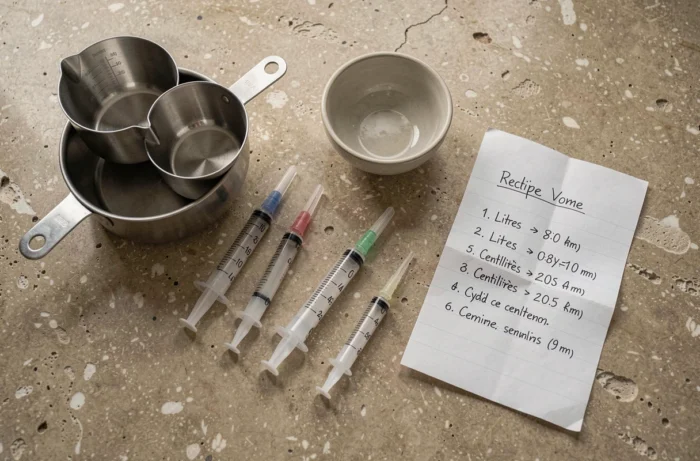
Most household situations involve liters and their submultiples: a bottle of water measured in liters, a laundry detergent cap measured in milliliters, or a measuring cup marked in centiliters. Cubic centimeters are used in a different context.
In mechanics, engine displacement is expressed in cm³. In medicine, infusion and injection volumes are measured in mL (or “cc” on older equipment). In science, volumes of solids calculated using geometric formulas naturally come out in cm³ or m³.
Converting between these two systems always comes down to using the link 1 mL = 1 cm³. From this reference point, you can scale up to liters (× 1,000) or to cubic meters (× 1,000,000) without changing the underlying logic.
Remembering three reference points is enough for most purposes: 1 L = 1,000 mL = 1,000 cm³, 1 cL = 10 mL = 10 cm³, and 1 m³ = 1,000 L. These three equations cover everything from reading a supermarket label to calculating the volume of an aquarium or checking a syringe marking.