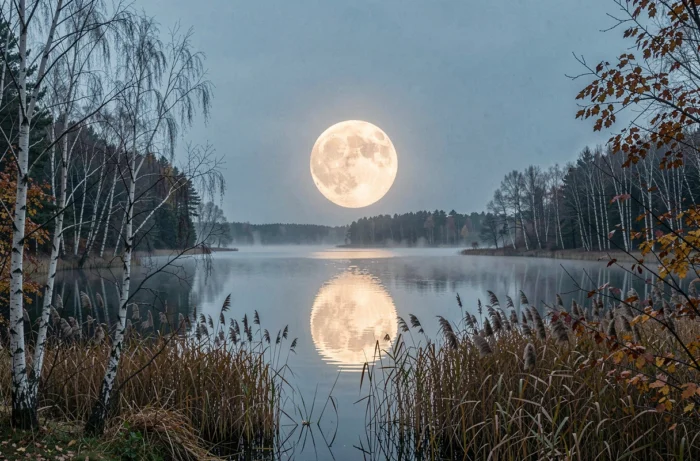
The Beaver Moon falls on Tuesday, November 24, 2026, at 14:53 UTC, or 3:53 p.m. Paris time. This full moon also qualifies as a supermoon, as the Moon will be near perigee. Two points to clarify from the outset: the full moon is a single global moment (the same time everywhere on Earth), and there is no universally agreed official definition of the term “supermoon” among astronomical organizations.
November 2026 supermoon: orbital criteria and the limits of the term
The supermoon label is based on how close the full moon is to lunar perigee. Timeanddate.com recently revised its own classification criteria, illustrating the lack of a standard. Neither the International Astronomical Union nor NASA has set an official threshold in kilometers or as a percentage of distance.
In practice, the Moon’s apparent diameter varies very little from one lunation to the next. The difference between a full moon at perigee and one at an average distance is difficult to perceive with the naked eye without a photographic comparison. The “big Moon” effect on the horizon is an optical illusion unrelated to perigee.
To observe the next full moon in November 2026 under the best conditions, choose the evenings of November 23 and 24. On the 23rd, the disk will already be nearly full, and by the evening of the 24th, the exact full moon will have passed by only a few hours.
Beaver Moon: a cultural attribution that needs context

The name “Beaver Moon” appears in most popular English-language calendars as an inheritance from the Indigenous peoples of North America. The documentary evidence is less clear-cut. The term appears in a travel account by Jonathan Carver published in 1778, but the author does not specify which people used the name or the exact seasonal context in which it was used.
Directly attributing the name to a specific Indigenous nation (Algonquin, Cree, or another) is therefore not supported by an identifiable primary source. Modern almanacs, beginning with the Farmers’ Almanac, popularized these monthly names by presenting them as a single, unified body of terms, even though they come from geographically and linguistically distinct traditions.
Why popular full moon names are not universal
Every agricultural or pastoral culture has its own seasonal markers. November marks the end of the trapping season in some parts of North America, but the olive harvest in the Mediterranean or rice-field preparation in Southeast Asia. Applying a single name to a lunation means treating a local calendar as universal.
- The Farmers’ Almanac’s monthly names compile terms from various origins without distinguishing the nations they come from.
- Jonathan Carver, the main reference cited, was a colonial explorer whose notes combine observations with personal interpretations.
- Several Indigenous peoples used lunar calendars with thirteen lunations, shifting month-by-month correspondences.
- In Europe, full moon names (Harvest Moon, Hunter’s Moon) follow a distinct agricultural logic, unrelated to North American naming conventions.
We recommend presenting these names as editorial conventions rather than ethnographic facts.
November 2026 lunar calendar: phases and related celestial events
The full moon on the 24th is not the month’s only celestial event. Here are the key dates to remember:
- November 24: Beaver Moon / supermoon (14:53 UTC).
- November 17–18: peak activity of the Leonids, best observed before dawn to avoid increasing lunar light pollution.
The Farmers’ Almanac notes that moonlight around November 24 will reduce the visibility of late Leonids. The best nights for spotting meteors will therefore be a week before the full moon, when the crescent Moon sets early.
Observing the Beaver Moon: practical conditions in mainland France
The exact full moon occurs in the middle of the afternoon in Paris (3:53 p.m. local time). At that moment, the Moon will not yet have risen over most of mainland France. Moonrise will take place in the late afternoon, and the disk will appear full throughout the night of November 24–25.
On the evening of the 23rd, the Moon will already be very close to 100% illumination. For photography or binocular viewing, this evening offers an advantage: the Moon rises slightly earlier, giving you more time before it crosses the meridian.
Visibility factors to check
In late November, weather in mainland France often makes observing difficult. Clear skies remain the deciding factor, far more so than the equipment you use. The Mediterranean regions and mountain areas above the cloud layer statistically offer the best viewing windows.
The November 24, 2026 supermoon brings a month rich in celestial events to a close. With the mid-November Leonids and this full moon near perigee, observers should plan their outings from the first half of the month so they are not relying on a single night.