Tai chi simultaneously engages three sensory systems (vision, inner ear, and proprioception) through slow, controlled weight shifts. This combined engagement explains its effectiveness for postural balance, as well as its limitations when practiced without complementary strength training.
Proprioception and weight shifts: the central mechanism behind tai chi’s effect on balance
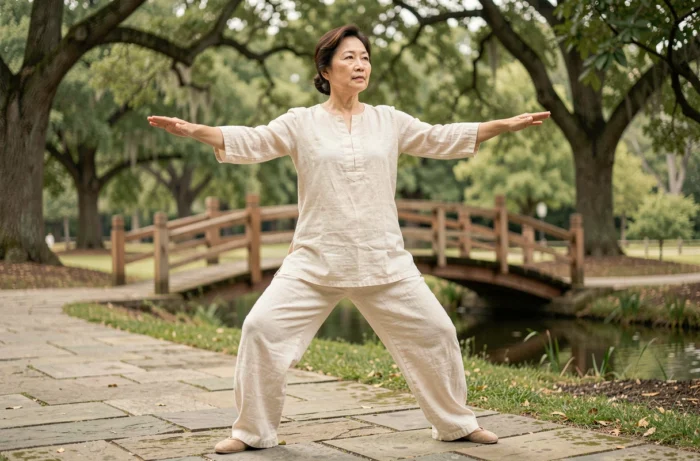
Balance training in tai chi is based on prolonged single-leg stances and slow transitions between postures. Unlike a static exercise such as the flamingo stance, practitioners shift from one supporting leg to the other without stopping, forcing the joint and muscle receptors to recalibrate continuously.
The supporting foot bears the body’s full weight while the other moves. This controlled imbalance stimulates proprioception in the ankle, knee, and hip through ranges of motion that ordinary walking does not engage.
Movement speed determines the proprioceptive challenge. The slower the movement, the longer the time spent standing on one leg, and the more the vestibular system has to compensate.
For those who want to learn how to practice tai chi with balance as their goal, choosing the right pace matters just as much as choosing the right form.
Tai chi and fall prevention: what the studies do (and don’t) say
Balance scores improve among regular practitioners, but it is worth distinguishing between measured improvements in balance and an actual reduction in falls. A better score on the Tinetti test does not guarantee that someone will fall less often in everyday life, where obstacles, lighting, and fatigue all play a part.
Combining tai chi with strength training
The same review reports that programs combining balance exercises with strength training achieve better average results in fall prevention than tai chi alone. We recommend adding at least two weekly sessions of quadriceps and ankle dorsiflexor strengthening to your practice.
- Partial squats or chair stands (8 to 12 repetitions) to strengthen the quadriceps and gluteus medius, which stabilize the knee when standing on one leg.
- Calf raises and dorsiflexion exercises with elastic resistance to strengthen the ankle muscles, which are engaged with every weight shift.
- Heel-to-toe walking along a line (tandem walk) at the end of a tai chi session to extend proprioceptive training under moderate muscle fatigue.
Tai chi movements for balance and mental calm
Not all movements in a form are equally effective for balance training. Postures that require clear single-leg support are the most beneficial.
Slow front kick (deng jiao)
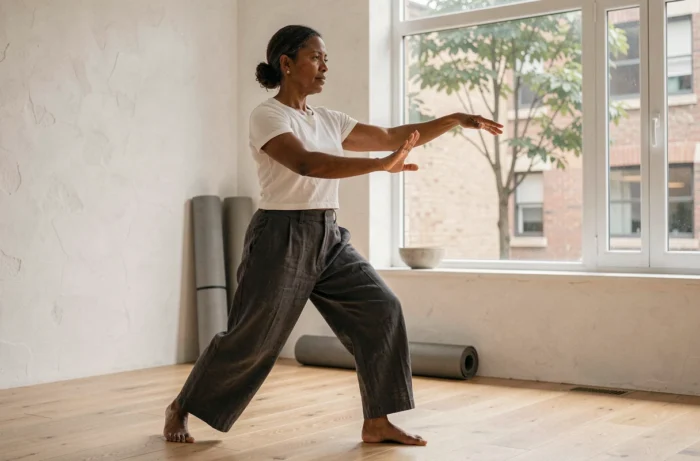
Holding the leg extended in a raised position places considerable demands on the vestibular system. The pelvis should remain neutral, without tilting sideways. Any compensation through the torso indicates weakness in the gluteus medius on the supporting side.
Repulse the Monkey (dao nian hou)
This backward movement requires you to place your foot without looking directly at the ground. Plantar proprioception and eye-foot coordination work together in an unfamiliar pattern. The repetitive, symmetrical nature of this movement also makes it meditative: attention focuses on the sensation of the ground beneath the foot, creating a sense of mental grounding similar to mindful walking.
White Crane Spreads Its Wings (bai he liang chi)
The upper- and lower-body dissociation (arms rising as the weight sinks into the supporting leg) requires practitioners to manage two motor intentions at once. This dual attentional task reduces mind-wandering and promotes a state of calm concentration.
Consistency and progression: the factors that determine results
International fall-prevention guidelines favor regular activity practiced over several months, with a structured progression.
Progression does not mean adding complex movements. Instead, it involves three practical adjustments:
- Gradually slowing the pace, which lengthens the time spent standing on one leg and increases the proprioceptive challenge.
- Closing your eyes during sequences you have mastered to remove visual input and make the inner ear and proprioception compensate.
- Practicing on slightly unstable surfaces (a thick mat or grass), which amplifies postural corrections and speeds up sensory adaptation.
A common pitfall is switching forms or styles too soon. The Yang style, the most widely practiced in the West, features long sequences that provide enough progressive challenge to maintain proprioceptive stimulation for years.
Tai chi and stress management: the role of abdominal breathing
The mental calm associated with tai chi is not simply a placebo effect of moving slowly. Abdominal breathing synchronized with movement activates the parasympathetic nervous system, lowering heart rate and cortisol levels.
Here is the key technique: inhale as you open (arms moving apart, body straightening), and exhale as you close or push. This breath-and-movement pairing creates a steady rhythm that works like an internal metronome.
Qigong shares this breathing principle with tai chi, but does not include the dynamic balance component. For a combined goal of improving balance and promoting calm, tai chi offers a more complete framework than static qigong or postural yoga because it keeps the body moving continuously while requiring strict breath control.
Tai chi is not a one-size-fits-all solution. Combined with targeted strength training and practiced with a structured progression in pace and sensory conditions, it becomes a precise tool for improving postural balance and fostering a lasting state of calm attentiveness.