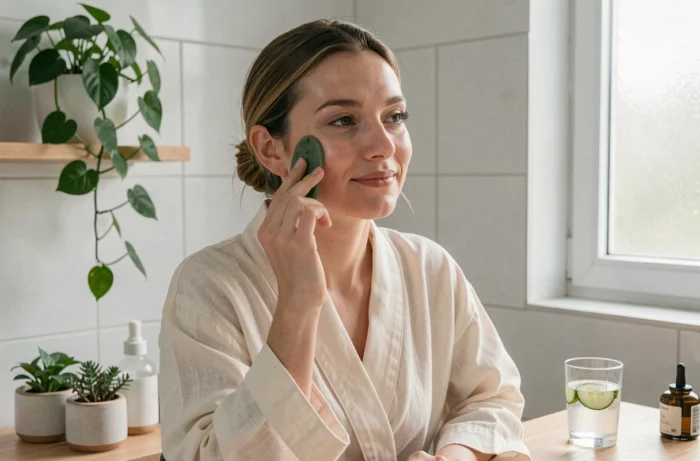
The beauty and wellness market is entering a phase where regulation, advances in cellular biology, and consumer demands for simplicity are reshaping routines. In Europe, new labeling requirements for fragrance allergens are significantly changing what brands can display on their packaging. Active ingredients derived from medical research are migrating to mainstream cosmetic care, while the trend towards minimalism in skincare routines is confirmed season after season.
Cosmetic Allergen Labeling: What Changes for Sensitive Skin
This season’s beauty trends are not limited to new active ingredients or textures. A European regulatory change is altering how cosmetic product compositions are declared, with direct consequences for individuals with reactive skin.
The regulation now distinguishes between two categories of products based on their mode of use. For leave-on products (creams, serums, lotions), individual indication of a fragrance allergen is required beyond 0.001 % concentration. For rinse-off products (shampoos, shower gels), this threshold rises to 0.01 %. Thus, the same component may appear on the label of a day cream but not on that of a face cleanser with a comparable concentration.
Several brands that follow the news on belle-et-bien.fr are already reformulating their products or adapting their packaging to include these mentions. The available space on packaging is becoming a constraint identified by industry professionals: as the number of allergens to declare increases, the readability of the label decreases.
Labeling changes do not uniformly apply to all batches at the same time. The distinction between market launch and stock availability creates a transition period. It is therefore possible to find, on the same shelf, two versions of an identical product with different composition mentions. Checking the INCI list remains the most reliable reflex for comparison.

Exosomes in Cosmetics: A Promising Active Ingredient with Unclear Limits
Exosomes are among the most discussed innovations in the field of skincare. These microvesicles, naturally produced by cells, play a role in intercellular communication. Their ability to transport biological signals has interested dermatological research for several years, and the cosmetic sector is now adopting them.
In practice, exosomes are integrated into serums and in-clinic treatments, often in conjunction with techniques like microneedling. The idea is to promote skin regeneration by stimulating cells in a targeted manner.
The main limitation lies in the lack of published clinical data specifically on topical cosmetic use. Existing studies mostly come from the medical field (wound healing, dermatology). Transposing these results to a serum applied daily on healthy skin raises questions about dosage, formulation stability, and actual penetration of the active ingredient. No European regulatory framework yet defines a standard for exosomes in cosmetics, leaving manufacturers with some leeway regarding possible claims.
Non-Invasive Treatments and LED Devices: Technology Replacing Surgical Procedures
HIFU, radiofrequency, LED, microneedling: these non-invasive technologies are gaining ground in clinics and increasingly at home. Their appeal lies in a compromise between perceived effectiveness and the absence of hospitalization.
LED masks are the most visible example of this migration to the home. Available at very variable prices, they offer different wavelengths (red for collagen stimulation, blue for antibacterial action). However, their adoption remains dependent on the regularity of use, a parameter that brands rarely mention in their communication.
- Red light (around 630 nm) targets skin aging by stimulating the activity of fibroblasts, the cells responsible for collagen production
- Blue light (around 415 nm) is used for its antibacterial properties, particularly on acne-prone skin
- Devices combining multiple wavelengths allow for treatment adaptation according to facial areas, but the power of home devices remains lower than that of professional devices
The regulation of these home devices deserves attention. Devices sold in France are not all subject to the same controls as those used in clinics. Checking CE compliance and the wavelengths announced by the manufacturer helps eliminate the least reliable products.

Minimalist Routine and Skincare: Fewer Products, More Results
The trend towards skinimalism, which emerged a few seasons ago, is consolidating. The principle: reduce the number of products to keep only those that meet an identified need. An appropriate cleanser, a moisturizing treatment, sun protection. Three steps instead of ten.
This approach stands in stark contrast to traditional Korean layering (seven to twelve steps), even though both philosophies coexist. Skinimalism particularly appeals to those whose skin reacts poorly to the accumulation of different formulations, a phenomenon that dermatologists describe as cosmetic overload.
The concrete benefit of this reduction also lies in the readability of compositions. With fewer products, it becomes easier to identify a problematic ingredient in case of a reaction. This point directly relates to regulatory developments on labeling: fewer layers of care mean fewer potential allergens in prolonged contact with the skin.
- Identify your skin type before choosing active ingredients: minimalist routines only work if each product is well-targeted
- Favor short formulations (fewer than fifteen ingredients) to facilitate tracking of compositions
- Spacing the introduction of new products by several weeks allows for isolating a potential reaction
Transitioning to a reduced routine is not trivial for brands. It involves concentrating more active ingredients into fewer references, which alters formulation and pricing strategies. Multifunctional products are gaining market share, but their effectiveness for each claimed function remains variable depending on the formulations.
This season’s beauty and wellness trends share a common thread: the search for transparency, whether regulatory, scientific, or in the composition of routines. Consumers have more tools to understand what they apply to their skin. The challenge shifts from access to information to the ability to sort it.